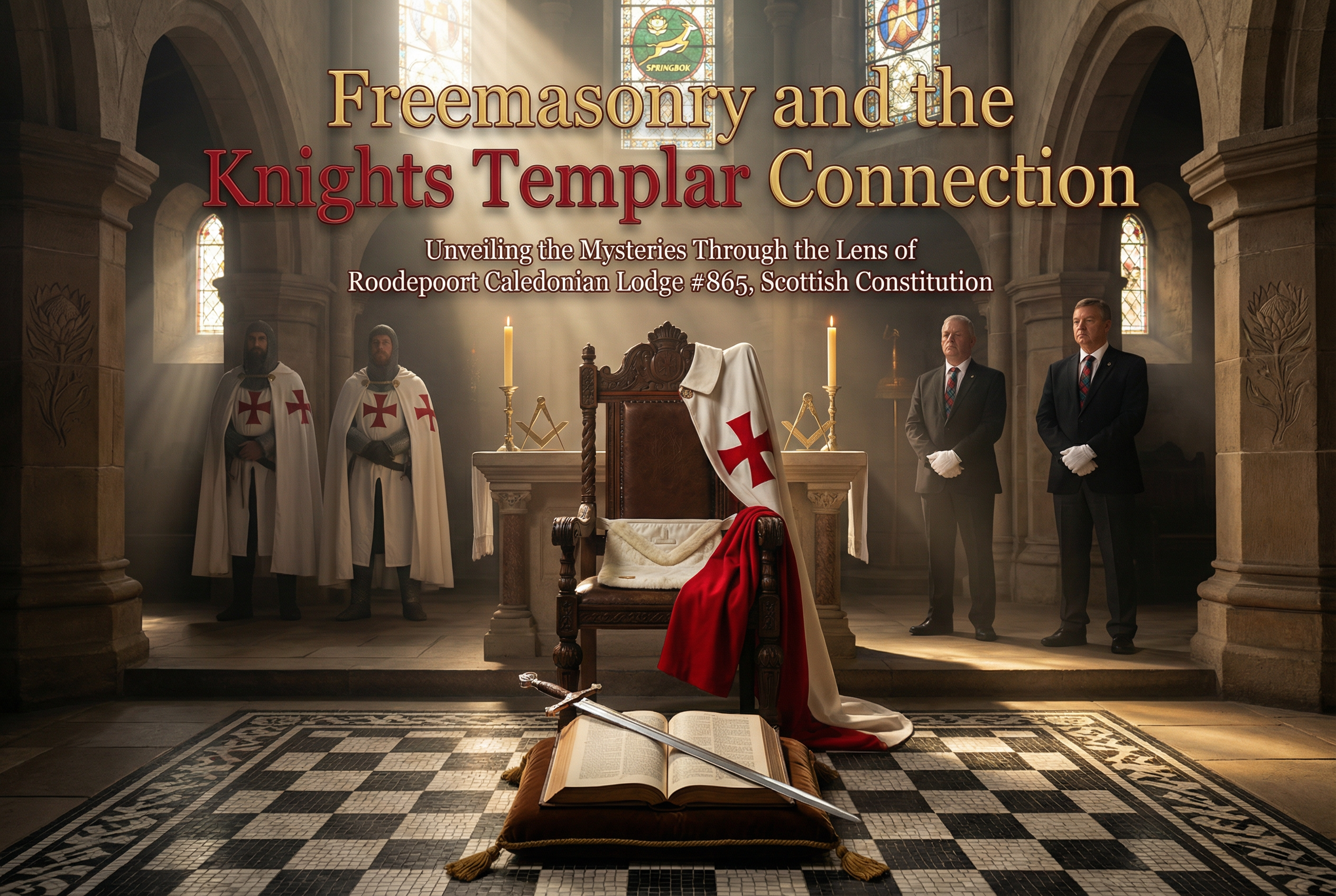
Unveiling the Mysteries Through the Lens of Roodepoort Caledonian Lodge #865, Scottish Constitution
Introduction: A Journey Through Time and Brotherhood
The first time I walked into the lodge room of Roodepoort Caledonian Lodge #865, I remember feeling an overwhelming sense of stepping into something far greater than myself. It was a crisp winter evening on the West Rand, and the familiar sounds of Roodepoort's bustling streets seemed to fade away as I crossed the threshold of our temple. The checkered floor gleamed beneath the soft glow of candlelight, and the solemn yet welcoming faces of my soon-to-be brethren regarded me with a mixture of curiosity and warmth that I have come to understand only deepens with time.
What struck me most profoundly that evening—and what continues to captivate my imagination years later—were the symbols adorning our sacred space. Among them, nestled between the square and compasses, the all-seeing eye, and the various tools of the operative mason, were motifs that seemed to whisper of something ancient, something that predated our Craft by centuries. A red cross here, a knight's imagery there, references in our ritual language that spoke of crusades, temples, and solemn vows made by warriors of faith long ago.
"What connection," I found myself wondering, "could possibly exist between a fraternity of symbolic stonemasons and the legendary warrior-monks of the medieval Crusades?"
That question, dear reader, has launched me on an extraordinary journey of discovery—one that has taken me through dusty archives, heated academic debates, whispered legends, and the living traditions of Freemasonry as practiced here in our beloved South Africa. And I believe it is a journey worth sharing, particularly through the unique lens of our own Roodepoort Caledonian Lodge #865, operating under the Scottish Constitution, a lodge with its own rich history intertwined with the broader tapestry of Masonic tradition.
Why This Connection Matters
You might wonder why anyone should care about an alleged connection between two organizations separated by centuries. After all, the Knights Templar were officially dissolved over seven hundred years ago, their leaders executed, their wealth confiscated, and their order scattered to the winds of history. Freemasonry, by contrast, emerged publicly in the early eighteenth century as a fraternal organization dedicated to moral improvement, charitable works, and brotherly love. What could these two possibly have in common beyond some shared symbolism and a penchant for secrecy?
The answer, I would argue, lies not merely in historical fact—though we shall explore that territory thoroughly—but in something more profound: the enduring human need for meaning, purpose, and connection to something transcendent. Whether the links between Freemasonry and the Knights Templar are literal, symbolic, or somewhere in between, they speak to our collective yearning to be part of a continuous chain of tradition, to participate in rituals that echo through time, and to aspire to ideals that have inspired men across generations.
For those of us who are members of lodges like Roodepoort Caledonian Lodge #865, this connection—real or mythical—enriches our experience immeasurably. When we gather in our temple, we are not merely performing quaint ceremonies invented a few centuries ago. We are participating in a living tradition that draws upon the symbolism, the ideals, and perhaps even the practices of the ancient mystery schools, the medieval craft guilds, the chivalric orders, and yes, the Knights Templar themselves.
The Intrigue and the Controversy
Of course, any discussion of the Freemasonry-Knights Templar connection must acknowledge the significant controversy surrounding this topic. On one side stand the romantic enthusiasts, who see direct and unbroken lines of descent from the Templars to modern Freemasonry, complete with secret initiations, hidden treasures, and mysterious revelations. On the other side are the skeptical historians, who dismiss such claims as fanciful nineteenth-century fabrications designed to add glamour to a fraternal organization seeking to boost its membership.
The truth, as is so often the case, likely lies somewhere in between. And that nuanced territory is precisely what we shall explore together in this comprehensive examination.
I write this not as a detached academic observer, but as a practicing Freemason—a proud member of Roodepoort Caledonian Lodge #865, operating under the Grand Lodge of Scotland. My perspective is inevitably colored by my experiences within the Craft, by the rituals I have participated in, and by the brotherhood I have experienced firsthand. Yet I shall endeavor to present the evidence fairly, to distinguish between established fact and tantalizing speculation, and to allow you, the reader, to draw your own conclusions.
What We Will Explore Together
In the pages that follow, we shall embark on a multifaceted journey through history, legend, and living tradition. We will begin by examining the historical origins and dramatic fall of the Knights Templar—those warrior-monks who rose from humble beginnings to become one of the most powerful organizations in medieval Christendom, only to be brought low by accusations of heresy and the machinations of a French king desperate for their wealth.
From there, we shall trace the emergence of speculative Freemasonry, exploring its roots in the operative stone mason guilds of medieval Scotland and England, its formalization in the early eighteenth century, and its rapid spread across the globe. We shall pay particular attention to the Scottish connection, which has special significance for our own lodge operating under the Scottish Constitution.
Next, we shall dive deep into the alleged connections between these two organizations. We will examine the theories that have been proposed—from direct lineage to symbolic inheritance—and weigh the evidence for and against each. We shall meet fascinating historical figures, from the martyred Jacques de Molay to the enigmatic founders of early Grand Lodges. And we shall attempt to separate the romantic myths from the documented facts, acknowledging that sometimes the myths themselves tell us something important about who we are and what we aspire to be.
Following this historical investigation, we shall turn our attention to the modern implications of this legacy. How do these connections—whether literal or symbolic—influence contemporary Freemasonry? What do they mean for lodges like ours, operating in the twenty-first century while drawing upon centuries of tradition? And how might understanding this heritage enrich both the practice of Freemasonry and our appreciation of history?
Finally, I shall share my personal reflections on what this journey of discovery has meant to me as a Freemason and as a seeker of truth. I shall offer some thoughts on how exploring these mysteries might benefit others who feel drawn to our ancient Craft, and I shall extend an invitation to those curious souls who might wish to learn more about Freemasonry in general and Roodepoort Caledonian Lodge #865 in particular.
A Note on Sources and Approach
Before we proceed, a brief word about methodology is in order. The historical terrain we shall traverse is notoriously treacherous, littered with forgeries, wishful thinking, and agenda-driven narratives. Serious scholars have spent careers attempting to separate fact from fiction in this domain, and their work—the writings of historians like Malcolm Barber on the Templars, or David Stevenson on early Scottish Freemasonry—provides the bedrock upon which our exploration rests.
At the same time, I am mindful that dry academic analysis alone cannot capture the living essence of what makes these traditions meaningful to those who practice them. There is a wisdom in ritual, in symbol, and in legend that transcends mere historical accuracy. The stories we tell about ourselves—even when those stories are more mythical than factual—shape who we become. This tension between critical history and lived tradition will animate our entire discussion.
So let us begin our journey, traveling back through the centuries to a time of crusades and holy wars, of warrior-monks and mysterious initiations, of tremendous power and spectacular downfall. The story of the Knights Templar awaits.
Historical Background: From Jerusalem to Edinburgh
The Knights Templar: Origins in the Holy Land
To understand any alleged connection between Freemasonry and the Knights Templar, we must first understand the Templars themselves—who they were, what they believed, and how they met their dramatic end. Their story begins in the aftermath of the First Crusade, in the newly conquered city of Jerusalem.
The year was 1099, and Christian armies from Western Europe had just achieved what many considered a miracle: the capture of Jerusalem from its Muslim rulers. Pilgrims from across Christendom now had access to the holiest sites of their faith—the Church of the Holy Sepulchre, the Mount of Olives, the Via Dolorosa where Christ was believed to have carried his cross. But the roads leading to Jerusalem remained perilous, infested with bandits who preyed upon the vulnerable faithful making their way to the Holy City.
Into this dangerous landscape stepped a small group of French knights, led by one Hugh de Payens, a nobleman from the Champagne region. Around 1119—the exact date is disputed—Hugh and eight companions took vows before the Patriarch of Jerusalem, pledging themselves to poverty, chastity, and obedience, as monks had done for centuries. But these were monks with a difference: they were also trained warriors, and their specific mission was the protection of Christian pilgrims traveling the dangerous roads of the Holy Land.
King Baldwin II of Jerusalem, recognizing the value of their mission, granted these warrior-monks quarters on the Temple Mount, in a wing of the royal palace adjacent to the Al-Aqsa Mosque, which the Crusaders believed to be the site of Solomon's Temple. From this location, the order derived its full name: the Poor Fellow-Soldiers of Christ and of the Temple of Solomon—the Knights Templar.
The Rise to Power and Prominence
What began as a small band of dedicated knights quickly grew into one of the most powerful organizations in medieval Christendom. Several factors contributed to this remarkable rise.
First and foremost was ecclesiastical endorsement. In 1129, the Council of Troyes officially recognized the order, and the influential Cistercian abbot Bernard of Clairvaux—later canonized as Saint Bernard—wrote a passionate defense of the Templars titled "In Praise of the New Knighthood." Bernard's endorsement gave the order tremendous spiritual credibility and opened the floodgates of noble recruitment.
Papal support followed. In 1139, Pope Innocent II issued the bull Omne Datum Optimum, which exempted the Templars from local laws, made them answerable only to the Pope, and freed them from the obligation to pay tithes. This extraordinary autonomy, combined with their growing reputation as fearless warriors, made the order increasingly attractive to European nobility.
But it was the Templars' financial innovations that truly set them apart. As an organization with properties across both Europe and the Near East, the Templars developed sophisticated methods of transferring funds across vast distances—essentially inventing early forms of banking. A pilgrim could deposit funds with the Templars in Paris and withdraw an equivalent amount in Jerusalem, avoiding the risk of carrying cash through dangerous territories. The order also provided loans to kings and nobles, accumulating substantial IOUs that would later prove both a source of power and, ultimately, their undoing.
At the height of their power, the Templars numbered perhaps twenty thousand members, including knights, sergeants, and chaplains. They owned properties throughout Europe and the Middle East, from vast estates in France and England to castles in the Crusader states. Their distinctive white mantles emblazoned with the red cross became synonymous with martial prowess and unshakeable faith.
The Templar Mystique: Secrecy and Ritual
Even during their heyday, the Templars were surrounded by an aura of mystery that continues to fuel speculation today. Much of this mystique derived from the secretive nature of their initiation ceremonies and chapter meetings. Like many religious orders, the Templars conducted their internal affairs behind closed doors, admitting only professed members to their most sacred rituals.
This secrecy, combined with their unprecedented power and wealth, naturally bred suspicion. Rumors circulated about what transpired in their closed chapters. Were they faithful servants of Christ, or did they harbor secret heresies acquired during their long sojourn in the East? Did their initiation ceremonies contain dark rites unknown to ordinary Christians? The very questions that were used to destroy the order would later resurface in the mythology connecting them to Freemasonry.
The Templars developed an elaborate hierarchical structure and a comprehensive Rule governing all aspects of their lives, from the conduct of battle to the proper way to eat meals. Their famous seal—depicting two knights riding a single horse—has been interpreted variously as symbolizing their original poverty, their brotherhood, or more esoteric meanings that enthusiasts have proposed over the centuries.
The Fall: Friday the Thirteenth, 1307
The Templar fall was as dramatic as their rise had been meteoric. By the early fourteenth century, the Crusader states had collapsed—the last Christian stronghold in the Holy Land, Acre, fell in 1291—and the Templars' original military purpose was becoming increasingly unclear. They were massively wealthy but seemingly without a mission, a dangerous combination in medieval politics.
King Philip IV of France—known as Philip the Fair—found himself deeply in debt to the Templars. Whether motivated primarily by financial desperation, genuine religious concerns, or political opportunism remains debated by historians. What is certain is that on Friday, October 13, 1307, Philip orchestrated one of the most carefully planned mass arrests in history. Across France, Templars were simultaneously seized and imprisoned, their properties confiscated.
The charges leveled against them were sensational: denial of Christ, spitting upon the cross, worshipping an idol called Baphomet, engaging in homosexual practices, and conducting sacrilegious initiation ceremonies. Under torture—employed freely by Philip's inquisitors—many Templars confessed to some or all of these accusations. Whether any of these confessions contained truth or were merely attempts to end the agony of torture remains fiercely contested.
Pope Clement V, a Frenchman under Philip's political influence, was placed in an impossible position. After years of negotiations, investigations, and political maneuvering, he dissolved the order at the Council of Vienne in 1312, transferring most of their properties to the rival Hospitallers.
The Execution of Jacques de Molay
The final act of the Templar tragedy came in 1314 when the last Grand Master, Jacques de Molay, and his companion Geoffroy de Charney were burned at the stake on an island in the Seine, in the shadow of Notre-Dame Cathedral. According to legend, as the flames consumed him, de Molay cursed both Philip and Clement, summoning them to appear before God within a year. Whether this curse was actually uttered or was a later invention, both men did indeed die within the year—Clement in April 1314 and Philip in November—adding a supernatural aura to the Templar legend.
The dying curse of Jacques de Molay would become a central element of Templar mythology and would later play a significant role in certain Masonic rituals and degrees. But what actually happened to the Templars after the dissolution? This question is crucial to any claimed connection with Freemasonry.
After the Dissolution: Survival and Speculation
The official dissolution of the order did not mean the elimination of all Templars. Many were acquitted of charges and either joined other orders (especially the Hospitallers) or lived out their lives as pensioners of the Church. In some regions, like Portugal, the order was simply reconstituted under a different name—the Order of Christ—which continued for centuries. In Spain, Templars merged with other orders or were absorbed into local military brotherhoods.
But what of those Templars who might have escaped the arrests entirely? This is where history shades into speculation, and where the seeds of the Templar-Masonic connection are first planted.
Scotland, under the excommunicated King Robert the Bruce, was one of the few places where papal bulls had limited force. Romantic tradition holds that a group of fleeing Templars made their way north, either by sea or overland, ultimately finding refuge in Scotland. Some versions of the legend place them at the Battle of Bannockburn in 1314, where Scottish forces decisively defeated the English army—supposedly with the help of a mysterious cavalry charge at a critical moment.
Did fugitive Templars fight at Bannockburn? There is no documentary evidence to support this claim, and most serious historians dismiss it as fantasy. Yet the legend persists, forming one strand of the rope that supposedly connects the medieval Templars to the later development of Scottish Freemasonry.
The Emergence of Freemasonry: From Operative to Speculative
To trace the alleged connection between Templars and Freemasons, we must now turn our attention to the origins of Freemasonry itself—a subject almost as contentious as Templar history.
The conventional historical narrative, accepted by most scholars, traces Freemasonry's origins to the operative stone mason guilds of medieval Europe, particularly those of Scotland and England. These guilds—like other craft organizations of the period—developed systems of mutual recognition, governed admissions to their trade, and maintained secrets related to their craft techniques.
The transition from "operative" Freemasonry (actual stonemasons) to "speculative" Freemasonry (non-masons using the symbolism of the craft for moral and philosophical purposes) occurred gradually over the sixteenth and seventeenth centuries. In Scotland, this transition is particularly well-documented thanks to the survival of early lodge records.
The Lodge of Edinburgh (Mary's Chapel), for instance, has records dating back to 1599, showing a continuous existence that predates the formal establishment of grand lodge organizations by over a century. The Schaw Statutes of 1598 and 1599—issued by William Schaw, Master of Works to King James VI of Scotland—provide remarkable insight into early Scottish masonic organization, including references to the "art of memory" and other elements suggesting a philosophical dimension to the craft already developing in the late sixteenth century.
Scotland: The Crucial Connection
Why does Scotland feature so prominently in theories connecting the Templars to Freemasonry? Several factors contribute to this Scottish emphasis.
First, as mentioned above, Scotland under Robert the Bruce was theoretically a refuge from papal authority when the Templars were being suppressed. The very survival of the Templars supposedly depended on Scottish hospitality.
Second, the historical record of early Freemasonry is far richer in Scotland than anywhere else. This allows us to trace the development of speculative elements within operative lodges earlier in Scotland than in England or on the Continent.
Third, certain Scottish sites—particularly Rosslyn Chapel, built by the Sinclair family in the mid-fifteenth century—seem to connect Templar imagery with proto-Masonic symbolism. Rosslyn's elaborate carvings, which include apparent representations of Masonic symbols alongside imagery that could be interpreted as Templar, have fueled centuries of speculation about hidden connections.
Fourth, the Sinclair family itself has played a pivotal role in Scottish Freemasonry. William St. Clair of Roslin served as a kind of hereditary protector of the Scottish crafts before the establishment of the Grand Lodge of Scotland in 1736. This same family had connections to the medieval Templars, creating a tantalizing—if tenuous—link across the centuries.
For those of us who operate under the Scottish Constitution, as we do at Roodepoort Caledonian Lodge #865, these Scottish roots carry special significance. When the Grand Lodge of Scotland was established in 1736, it represented the formalization of a tradition that had been developing in Scottish lodges for at least two centuries. That tradition, whether or not it literally connects to the Templars, carries with it the weight of remarkable antiquity and a rich symbolic heritage.
The Eighteenth Century: Grand Lodges and New Narratives
The foundation of the Premier Grand Lodge of England in 1717 and the Grand Lodge of Scotland in 1736 marked the beginning of organized, institutional Freemasonry. With this organization came the systematization of ritual, the development of higher degrees beyond the initial three (Entered Apprentice, Fellow Craft, and Master Mason), and the emergence of elaborate origin myths designed to give the Craft an illustrious pedigree.
It was in this context that the Templar connection began to be explicitly developed within Masonic ritual and legend. The Chevalier Ramsay, a Scottish Jacobite living in France, delivered a famous oration in 1737 suggesting that Freemasonry originated with the Crusader knights—though interestingly, he pointed to the Knights of St. John (Hospitallers) rather than the Templars specifically.
But it was in Germany that the Templar connection reached its most elaborate development. The Rite of Strict Observance, founded by Baron von Hund in the 1750s, claimed not merely inspiration from the Templars but direct descent. Von Hund asserted that he had been initiated into a secret order directly descended from the medieval Templars, surviving underground since their dissolution. This "Unknown Superiors" narrative proved immensely attractive, and the Rite of Strict Observance spread rapidly across Continental Europe.
Was there any truth to von Hund's claims? Almost certainly not, in any literal sense. The "Unknown Superiors" were never produced, and the whole affair seems to have been a combination of sincere belief, wishful thinking, and possibly deliberate mystification. Yet the Templar-Masonic connection was now firmly established in the consciousness of the Craft, and it would continue to develop in various forms through the nineteenth and twentieth centuries.
Exploring the Connection: Theories, Evidence, and Controversies
The Great Debate: Continuity or Invention?
As we delve deeper into the alleged connections between Freemasonry and the Knights Templar, we encounter a fundamental question that has divided researchers for centuries: Is there genuine historical continuity between these organizations, or was the connection essentially invented by eighteenth-century Freemasons seeking to enhance the prestige and mystery of their Craft?
The honest answer is that we simply do not know with certainty. The documentary record is frustratingly incomplete, and what evidence exists is subject to wildly divergent interpretations. What we can do is carefully examine the various theories that have been proposed, assess the evidence for and against each, and draw tentative conclusions that acknowledge our uncertainty.
Let us examine the principal theories in turn.
Theory One: Direct Lineage
The most ambitious claim—and the one with the least scholarly support—is that modern Freemasonry is literally descended from the Knights Templar in an unbroken line of transmission.
According to this theory, when the Templars were suppressed in 1307-1312, some members of the order escaped destruction and went underground. They preserved their rituals, their knowledge, and their organizational structure in secret, eventually transmitting these to the emerging Masonic lodges of the sixteenth and seventeenth centuries. In this view, Freemasonry is essentially the Templars rebranded—the same organization operating under a new name.
What evidence supports this theory? Proponents point to several factors:
- The Templar refuge in Scotland narrative, suggesting that fleeing Templars found sanctuary under Robert the Bruce and eventually merged with the operative mason guilds.
- Similarities between certain Templar practices (hierarchical grades, secret initiation rituals, the use of passwords and signs of recognition) and later Masonic practices.
- The symbolism shared between the two organizations, including the red cross, the skull and crossbones, and references to building and the Temple of Solomon.
- The explicit Templar content in certain higher Masonic degrees, particularly those of the York Rite and Scottish Rite.
However, the evidence against direct lineage is substantial:
- There is a significant chronological gap between the Templar suppression (early fourteenth century) and the earliest evidence of speculative Freemasonry (late sixteenth century). If the Templars survived underground for over two centuries, they left no discernible trace in the documentary record.
- The earliest Scottish lodge records make no reference to Templars. If the lodges had been secretly Templar organizations, one would expect some hint of this in their internal documents.
- The Templar content in Masonic degrees appears to have been added in the eighteenth century, well after the establishment of organized Freemasonry, suggesting that it was a later embellishment rather than an original element.
- Most serious historians who have examined the evidence conclude that direct lineage is extremely unlikely.
Theory Two: The Scottish Refuge Narrative
A somewhat less ambitious version of the continuity theory focuses specifically on Scotland as a Templar refuge. This narrative, popularized by books like "The Temple and the Lodge" by Michael Baigent and Richard Leigh, suggests that fugitive Templars made their way to Scotland after 1307, where they found protection under the excommunicated King Robert the Bruce.
According to this theory, these Templars eventually merged with the Scottish operative mason lodges, contributing elements of their ritual and symbolism to what would become speculative Freemasonry. The connection is not necessarily direct and unbroken, but rather represents a transmission of influence over time.
The evidence for this theory includes:
- Scotland's unique political situation during the Templar suppression, which theoretically made it a safe haven.
- The prominent role of Scotland in the early development of speculative Freemasonry.
- The connections between the Sinclair family (associated with both Rosslyn Chapel and early Scottish Freemasonry) and the medieval Templars.
- The alleged Templar gravestones at places like Kilmartin and other Scottish locations.
The evidence against includes:
- The lack of any documentary evidence that Templars actually fled to Scotland in significant numbers.
- The fact that while Scotland was technically under interdict, the church still functioned there, and papal bulls were not entirely without force.
- Alternative explanations for the "Templar" gravestones, which many scholars believe are actually memorials to non-Templar warriors.
- The long gap between any possible Templar arrival and the development of speculative Freemasonry.
Theory Three: Symbolic Inheritance
A third theory, which I personally find most compelling, suggests that the connection between Freemasonry and the Knights Templar is primarily symbolic and inspirational rather than organizational or genealogical.
According to this view, the Freemasons who developed the higher degrees in the eighteenth century drew upon Templar imagery and legend not because they were themselves descended from Templars, but because the Templar story offered powerful symbolic material for their purposes. The martyrdom of Jacques de Molay, the themes of loyalty unto death, the struggle against tyrannical persecution, the idea of guardians protecting sacred secrets—all of these resonated with Masonic themes and provided rich material for ritual drama.
In this interpretation, the Templar degrees are not historical relics but creative constructions—yet they are no less meaningful for that. They allow Masons to participate symbolically in a tradition of sacrifice and dedication, to identify with noble ideals, and to connect with the romance of medieval chivalry.
This theory has several advantages:
- It is consistent with the documentary record, which shows Templar elements being introduced into Freemasonry in the eighteenth century rather than being present from the beginning.
- It explains why the Templar content in Masonic degrees is heavily romanticized and does not accurately reflect what we know of actual Templar practice.
- It acknowledges the power and meaning of these traditions without requiring historical claims that cannot be substantiated.
- It is the interpretation favored by most mainstream Masonic historians.
Rosslyn Chapel: The Stone Enigma
No discussion of the Templar-Masonic connection would be complete without addressing Rosslyn Chapel, that extraordinary fifteenth-century structure in Scotland that has become a focal point of speculation.
Built by Sir William St. Clair beginning in 1446, Rosslyn Chapel is adorned with an almost overwhelming profusion of carved stone imagery. Among these carvings, enthusiasts have identified what they believe to be Masonic symbols (square and compasses, various geometric designs) alongside Templar imagery (knights on horseback, symbols that might represent Templar crosses).
The presence of these symbols has been cited as evidence that the Sinclairs—who would later play a prominent role in Scottish Freemasonry—were preserving Templar knowledge and incorporating it into proto-Masonic symbolism.
However, skeptical scholars offer alternative interpretations:
- Many of the supposedly "Masonic" carvings may simply be medieval Christian or alchemical symbols with no specific connection to Freemasonry.
- The chapel was built over a century after the Templar suppression—if the Sinclairs were preserving Templar secrets, why wait so long to encode them in stone?
- The identification of specific symbols is often subjective, with observers seeing what they expect to find.
Having visited Rosslyn myself, I can attest to its mysterious atmosphere and the genuine difficulty of interpreting its complex iconography. Whatever the truth about its connection to Templars or Masons, the chapel remains a remarkable testament to medieval craftsmanship and a powerful symbol of Scotland's role in these interconnected traditions.
Key Figures: Jacques de Molay and Beyond
The figure of Jacques de Molay, the last Grand Master of the Knights Templar, looms large in both Templar history and Masonic legend. His dramatic execution—burned at the stake after recanting his forced confession—has made him a potent symbol of integrity in the face of persecution.
In several Masonic degrees, particularly those associated with the Order of the Temple (Knights Templar) within the York Rite, the story of de Molay's martyrdom plays a central role. Candidates may be invited to contemplate his example, to identify with his suffering, and to commit themselves to similar loyalty and honor.
Whether the historical de Molay was actually the paragon of virtue presented in these rituals is, of course, debatable. The real de Molay was a complex figure who initially confessed to the charges against the order (under torture) before recanting. His leadership during the order's crisis has been both praised and criticized by historians.
But in the context of Masonic ritual, historical accuracy is less important than symbolic power. De Molay represents an ideal—the man who refuses to betray his brothers even at the cost of his life. This ideal resonates with Masonic values of fidelity and brotherhood, making de Molay a natural figure to incorporate into Masonic legend.
Other figures connecting the Templar and Masonic worlds include:
- Robert the Bruce: The Scottish king under whose protection the Templars supposedly found refuge. Later, the Scottish-American youth organization associated with Masonry, the Order of DeMolay, would incorporate Bruce's story alongside de Molay's.
- Andrew Michael Ramsay: The Chevalier Ramsay, whose 1737 oration first proposed a Crusader origin for Freemasonry, establishing a template that later writers would develop with specific reference to the Templars.
- Baron von Hund: The German nobleman who founded the Rite of Strict Observance, claiming direct Templar descent and the existence of "Unknown Superiors" preserving the order's secrets.
Separating Myth from Fact: The Dan Brown Effect
Any contemporary discussion of the Templar-Masonic connection must acknowledge the enormous impact of popular culture, particularly Dan Brown's novels "The Da Vinci Code" and "The Lost Symbol." These bestselling thrillers, along with earlier works like "The Holy Blood and the Holy Grail" by Baigent, Leigh, and Lincoln, have brought Templar-Masonic speculation to a mass audience.
It is worth clearly distinguishing between the claims made in these popular works and what serious historians have been able to establish:
Popular Claims:
- The Templars discovered secret knowledge under the Temple Mount, including proof of an alternative version of Christian history.
- The Templars were the guardians of the Holy Grail, variously interpreted as the cup used at the Last Supper or as a code for the bloodline of Christ.
- Freemasonry is the direct continuation of the Templar order, preserving their secrets to this day.
- Masonic symbols contain encoded messages revealing these hidden truths.
Historical Reality:
- There is no evidence that the Templars discovered anything unusual under the Temple Mount. Archaeological excavations have found no indication of secret chambers or hidden artifacts.
- The Holy Grail legend developed independently of the Templars, first appearing in medieval romances with no apparent Templar connection.
- As we have discussed, direct organizational continuity between Templars and Freemasons is extremely unlikely based on the documentary record.
- Masonic symbols, while rich in meaning, are drawn from the operative craft of stonemasonry and the broader Western esoteric tradition. They do not encode secret historical information.
This is not to say that the popular narratives are without value. They have inspired millions of people to take an interest in medieval history, Freemasonry, and the mystery traditions of the West. Many brethren in lodges like ours first became curious about Freemasonry after reading Dan Brown or similar authors. But it is important to approach the Craft with realistic expectations, prepared to find something different from—but potentially even more meaningful than—the sensationalized versions presented in fiction.
The Templar Degrees: Ritual Reality
Whatever the historical relationship between Templars and Masons, the ritual relationship is undeniable. Several Masonic bodies explicitly incorporate Templar themes, degrees, and symbolism.
The York Rite's Order of the Temple: In many jurisdictions, the York Rite includes an order called the Knights Templar, in which candidates are "knighted" as Christian soldiers. This order, while not claiming literal descent from the medieval Templars, draws extensively on Templar imagery and narrative. Members receive titles like "Sir Knight" and participate in rituals featuring crusader themes.
The Scottish Rite: Various degrees within the Scottish Rite also incorporate Templar elements, though the nature and extent vary by jurisdiction. The degree of Knight of the East and West, for instance, contains Templar imagery, as do several others.
Other Bodies: Various other Masonic and quasi-Masonic organizations—from the Societas Rosicruciana to various Continental rites—incorporate Templar themes to greater or lesser degrees.
What do these ritual bodies actually teach? Without revealing any secrets that are not already publicly available, we can say that the Templar degrees generally emphasize:
- Christian faith and chivalric virtue
- Loyalty unto death, as exemplified by Jacques de Molay
- The struggle against tyranny and persecution
- The protection of the innocent and the pursuit of justice
- The perpetuation of a tradition of honorable warriors
Whether one interprets these teachings as the continuation of actual Templar traditions or as the creative appropriation of Templar symbolism for moral instruction, they represent a significant element of the Masonic experience for many brethren.
Academic Perspectives: What Scholars Say
It is worth summarizing the current state of academic opinion on the Templar-Masonic connection, as this provides important context for evaluating the various theories.
Most mainstream historians of Freemasonry—including leading scholars like David Stevenson, Margaret Jacob, and Andrew Prescott—are skeptical of claims of direct continuity between the Templars and Freemasonry. They point to the lack of documentary evidence, the long chronological gap, and the clear evidence that Templar elements were introduced into Masonry in the eighteenth century rather than being present from the beginning.
Similarly, historians of the Knights Templar—scholars like Malcolm Barber, Helen Nicholson, and Juliet Barker—generally reject the more sensational claims about Templar survival and secret knowledge. They present the Templars as a remarkable but ultimately understandable phenomenon of medieval religious and military history, not as mysterious guardians of arcane secrets.
However, these scholars do not dismiss the cultural connection entirely. They acknowledge that:
- The Templars became an important symbolic resource for later esoteric and fraternal movements, including Freemasonry.
- The appropriation of Templar imagery was part of a broader eighteenth-century fascination with chivalry, the medieval, and the mysterious.
- The legends connecting Templars and Masons, while not literally true, tell us important things about the self-understanding and aspirations of early modern fraternal organizations.
In other words, the connection may be mythological rather than historical, but it is no less real or significant for that. Myths have power, and the Templar myth has certainly shaped Freemasonry in important ways.
Modern Implications and Relevance: Living the Legacy
Contemporary Freemasonry: Heir to a Tradition
As a member of Roodepoort Caledonian Lodge #865, operating under the Grand Lodge of Scotland here in South Africa, I find myself part of a living tradition that connects—symbolically if not literally—to the medieval past we have been exploring. But what does this connection actually mean in practice? How does the Templar legacy influence modern Freemasonry, and why should it matter to contemporary seekers?
These are questions I have pondered often, particularly during those contemplative moments in our lodge room when the ritual pauses and we are invited to reflect on the deeper meanings of our Craft. And I believe the answers speak to something fundamental about what Freemasonry offers in the twenty-first century.
The Enduring Appeal of Chivalric Ideals
At its core, the Templar connection speaks to a longing for noble ideals in an often cynical world. The medieval knight—sworn to protect the weak, to fight for justice, to remain true unto death—represents an archetypal ideal of masculine virtue that continues to resonate across centuries.
Of course, the historical reality of medieval knighthood was often far from this ideal. Knights could be brutal, self-serving, and violent. The Crusades themselves were marked by atrocities on all sides. But ideals are not diminished by the failure of individuals to live up to them; rather, the ideal serves as a standard against which we measure ourselves and find the motivation to improve.
When Freemasons participate in rituals that invoke the Templar legacy, they are not claiming to be medieval warriors or pretending that historical crusaders were paragons of virtue. Rather, they are connecting themselves to an ideal of selfless service, courageous integrity, and unwavering loyalty that transcends any particular historical context.
These ideals are desperately needed in our contemporary world, where cynicism often masquerades as sophistication and where commitment to anything beyond self-interest is frequently mocked. Freemasonry, drawing on the Templar tradition, offers an alternative vision—one in which men are called to be better than they are, to serve causes greater than themselves, and to remain true to their principles even when doing so is difficult.
The Scottish Constitution: A Special Heritage
For those of us who are members of lodges under the Grand Lodge of Scotland, the Templar connection carries particular resonance. As we have seen, Scotland plays a crucial role in the romantic narratives linking Templars to Masons. Whether or not these narratives are literally true, they form part of the cultural heritage of Scottish Freemasonry.
The Grand Lodge of Scotland, founded in 1736, traces its lineage to some of the oldest continuously operating lodges in the world. When we at Roodepoort Caledonian Lodge #865 conduct our rituals according to Scottish usage, we are participating in traditions that have been preserved and transmitted for centuries.
This sense of connection to the past is not mere antiquarianism. It provides a framework of meaning within which our activities take on greater significance. When I sit in our lodge room, I am aware that brethren before me—in Scotland, in South Africa, and around the world—have sat in similar rooms, heard similar words, and contemplated similar symbols. This chain of connection extends back through time, linking us not only to our immediate predecessors but to all those who have walked the Masonic path before us.
And yes, in my more imaginative moments, I like to think that this chain might extend back even further—to those mysterious medieval warrior-monks who perhaps, just perhaps, contributed something of their spirit to the Craft we practice today.
Brotherhood in Practice: The Work of the Lodge
But Freemasonry is not merely about contemplating the past or participating in rituals that connect us to ancient traditions. It is also about practical work in the present—the building of brotherhood, the practice of charity, and the pursuit of moral improvement.
At Roodepoort Caledonian Lodge #865, we take these obligations seriously. Our lodge is a community of men from diverse backgrounds—different professions, different ages, different life experiences—united by a common commitment to the principles of our Craft. When we meet for our regular communications, we do more than perform rituals; we build relationships, support one another through life's challenges, and work together for the benefit of our community.
Charity is central to our work. Following in the footsteps of both the medieval craft guilds (which looked after their members in need) and the chivalric orders (which were dedicated to the service of others), we contribute to various charitable causes. These range from supporting educational initiatives to providing assistance to those experiencing hardship. The specific causes vary, but the underlying principle remains constant: we who have been blessed are called to share those blessings with others.
This charitable orientation connects us, in spirit if not in direct lineage, to the original mission of the Knights Templar—the protection and assistance of vulnerable pilgrims. The circumstances have changed, but the fundamental impulse remains the same: to use our resources and our organization for the benefit of those in need.
Moral Philosophy: The Templar as Exemplar
One of the most important functions of Masonic ritual is moral instruction. Through allegory, symbol, and dramatic narrative, the rituals of Freemasonry teach lessons about virtue, integrity, and the conduct of a well-lived life. The Templar degrees, in particular, offer rich material for this kind of moral reflection.
Consider the story of Jacques de Molay as it is presented in Masonic tradition. Here is a man who, under tremendous pressure and threat of death, initially fails—confessing to crimes he did not commit. But when given the opportunity to save his life by maintaining those confessions, he instead recants, choosing truth and integrity over survival. This is a powerful example of moral courage, and it speaks to a fundamental Masonic teaching: that there are principles more important than our own comfort or even our own lives.
The Templar symbolism also emphasizes the importance of sacred commitments. The medieval Templars took solemn vows—of poverty, chastity, and obedience—which they were bound to honor. While modern Freemasons do not take identical vows, we do make serious obligations as part of our initiation and advancement. The Templar example reminds us that these obligations are not mere formalities but binding commitments that should shape our conduct.
Roodepoort Caledonian Lodge #865: Our Unique Story
Allow me to share a bit more about our own lodge, Roodepoort Caledonian Lodge #865. Situated in the West Rand of Johannesburg, our lodge has been a presence in the South African Masonic landscape for many decades. Operating under the Grand Lodge of Scotland, we maintain the distinctive traditions of Scottish Freemasonry while adapting them to our local context.
The name "Caledonian" itself speaks to our Scottish heritage. Caledonia, the ancient name for Scotland, connects us to the land where speculative Freemasonry took its earliest documented form. When we identify ourselves as Caledonian Masons, we are claiming a heritage that stretches back to those pioneering lodges of Edinburgh, Kilwinning, and elsewhere in Scotland.
Yet we are also proudly South African. Our membership reflects the diversity of our nation, and our activities are rooted in our local community. We are not merely an outpost of Scottish tradition but a living, evolving lodge that brings together the ancient and the contemporary, the universal and the particular.
Our regular meetings feature the beautiful ritual work of Scottish Freemasonry, conducted with care and reverence. We also engage in fellowship—sharing meals, conversations, and the simple pleasures of brotherhood. And we look outward, contributing to charitable causes and welcoming those who are curious about our Craft.
For those who feel drawn to explore Freemasonry—whether because of an interest in the Templar connection, a desire for moral growth, a search for meaningful community, or simple curiosity—I would warmly encourage you to reach out to us. Information about our lodge is available on our website, and we are always happy to hear from potential candidates who approach us with sincerity and good intentions.
The Quest Continues: Freemasonry in the Modern World
As I reflect on the Templar-Masonic connection and its relevance to contemporary practice, I am struck by how the themes of medieval crusading spirituality continue to resonate in our very different world.
We may not be called to literal warfare in defense of holy sites, but we are called to struggle against the forces of ignorance, injustice, and moral complacency within ourselves and our society. The Templar ideal of the warrior-monk—equally comfortable with the sword and with prayer—translates into a modern ideal of engaged spirituality, of faith put into action, of contemplation balanced by service.
We may not face inquisitors who threaten us with torture if we do not recant our beliefs, but we do face social pressures to conform, to abandon our principles for the sake of convenience, to choose the easy path rather than the right one. The example of Jacques de Molay, choosing the flames rather than betraying his integrity, challenges us to similar courage in our own contexts.
And we may not live in a world of castles, crusades, and kings, but we still need places where we can step out of ordinary time and space, connect with something transcendent, and renew our commitment to living purposefully. The lodge room, with its symbols and rituals, provides such a space—a modern temple where men can still seek light.
An Invitation to Explore
To those reading this who are not Freemasons but find themselves intrigued by what I have described, I extend a sincere invitation to explore further. Freemasonry is not a closed society; it is a private organization that welcomes inquiry from men of good character who seek moral and spiritual growth.
The path to membership typically begins with a simple inquiry. In the case of our own Roodepoort Caledonian Lodge #865, this might mean visiting our website, attending a public event if one is available, or simply reaching out to a member you may know. The process is neither mysterious nor complicated: it involves meeting with members of the lodge, discussing your motivations and expectations, and—if both parties agree—submitting a petition for membership.
Once a member, you will embark on a journey through the degrees of Freemasonry, each building upon the last, each offering new insights and challenges. Should you choose to pursue the additional degrees of the York Rite or Scottish Rite, you will encounter more explicitly Templar themes and rituals. But even the fundamental three degrees of Craft Masonry contain the seeds of the moral and spiritual teachings that the Templar connection represents.
What will you find in Freemasonry? Not secret political conspiracies or hidden treasure. Not magical powers or occult knowledge. You will find, instead, a community of men striving to become better versions of themselves. You will find rituals that speak to deep truths about human nature and the human condition. You will find symbols that, properly contemplated, can illuminate your path through life. And you will find brothers—men who will stand with you in good times and bad, who will celebrate your successes and support you through your struggles, who will challenge you to grow and forgive you when you fall short.
This is the true legacy of the Knights Templar, whether that legacy is transmitted through literal descent or through symbolic appropriation. It is a legacy of commitment, service, and brotherhood. And it is a legacy that is still very much alive at Roodepoort Caledonian Lodge #865 and in Masonic lodges around the world.
Personal Reflections and Conclusion: What This Journey Has Meant
My Own Path to Freemasonry
As I bring this exploration to a close, I find myself reflecting on my own journey within the Craft—a journey that began with curiosity and has led to a profound sense of belonging and purpose.
I first encountered Freemasonry, as many do, through popular culture. I had read some of the sensational books, watched documentaries about hidden secrets and mysterious symbols, and developed a vague impression of the Craft as something simultaneously sinister and fascinating. Like many, I half-believed that Freemasons possessed secret knowledge passed down from ancient times—knowledge that might include, among other things, the secrets of the Knights Templar.
What I found when I actually began investigating Freemasonry was both different from and better than my expectations. There were no world-changing secrets whispered to me upon initiation. No maps to buried treasure. No proof of alternative histories or hidden bloodlines. Instead, I found something far more valuable: a community of thoughtful men engaged in the serious work of self-improvement, and a system of symbols and rituals that, properly understood, can genuinely transform how one approaches life.
The Templar connection, I came to understand, was not about literal descent from medieval warriors. It was about aspiring to the ideals those warriors represented—ideals of courage, integrity, service, and faith. Whether the historical Templars actually lived up to those ideals is less important than the fact that the ideals themselves are worth pursuing.
The Lodge as Sacred Space
One of the most profound aspects of my Masonic experience has been discovering the lodge room as a sacred space—a place set apart from the ordinary world where different rules apply. When I enter our temple at Roodepoort Caledonian Lodge #865, I cross a threshold not just physically but psychologically and spiritually. The concerns of daily life—the petty conflicts, the mundane worries, the constant distractions—fall away, and I find myself in a space dedicated to contemplation and brotherhood.
This experience of sacred space connects, I believe, to the deepest roots of the Masonic tradition. The medieval stonemasons who built the great cathedrals understood that they were creating spaces designed to inspire awe, to lift the human spirit toward the divine. The Templars, with their devotion to the Temple of Solomon and their construction of magnificent churches throughout Christendom, shared this understanding. And we, their symbolic inheritors, continue to create and maintain sacred spaces where the work of the spirit can proceed.
Our lodge room may not be as grand as a medieval cathedral or a Templar preceptory. But when the lodge is opened according to ancient custom, when the candles are lit and the symbols unveiled, when the brothers stand in their appointed places and the ritual words are spoken—in those moments, we are participating in something timeless. We are connected to all who have sought light through the ages, and we are creating the conditions for genuine transformation.
Lessons Learned Along the Way
What specific lessons have I taken from my exploration of the Templar-Masonic connection? Let me share a few that seem particularly significant.
First, the importance of critical thinking. My investigation of this topic has taught me to approach sensational claims with healthy skepticism while remaining open to genuine mysteries. Not everything claimed about the Templar connection is true, but dismissing all of it as nonsense would be equally mistaken. The truth lies somewhere in the nuanced middle ground, and finding it requires careful attention to evidence and arguments.
Second, the power of myth. Even if the direct connection between Templars and Masons is mythological rather than historical, that mythology serves important purposes. It provides a framework of meaning, a source of inspiration, and a sense of connection to something greater than ourselves. The stories we tell about our origins shape who we become, and the Templar story—with its themes of heroic sacrifice, mysterious wisdom, and enduring brotherhood—is a powerful story indeed.
Third, the value of tradition. In a world that often seems obsessed with novelty and change, there is something deeply satisfying about participating in traditions that connect us to the past. When I take part in Masonic rituals that have been performed for centuries, I feel a sense of rootedness and continuity that is increasingly rare in modern life. This is not mere nostalgia; it is a recognition that wisdom accumulates over generations and that we are trustees of something precious that we must preserve and transmit.
Fourth, the necessity of brotherhood. The Templars were, above all, a brotherhood—men bound together by sacred vows and common purpose. This is precisely what Freemasonry offers as well. In an age of isolation and fragmentation, the opportunity to be part of a genuine community of men committed to mutual support and moral improvement is invaluable. My brothers at Roodepoort Caledonian Lodge #865 have become true friends—men I can rely upon in times of difficulty and celebrate with in times of joy.
Fifth, the call to service. Both the Templars and Freemasonry emphasize service to others as a fundamental obligation. This reminder that we are called to use our abilities and resources for the benefit of others—not merely for our own advancement—is a corrective to the selfishness that can so easily dominate modern life. Whether through formal charitable programs or individual acts of kindness, the Masonic brother is challenged to make a positive difference in the world.
What Freemasonry Has Given Me
If I were to summarize what Freemasonry has given me, I might put it this way: it has given me a path. Not a path in the sense of answers to every question or solutions to every problem, but a path in the sense of a direction of travel, a set of markers to guide my way, and companions for the journey.
Before I became a Mason, I often felt adrift—successful enough in worldly terms, but lacking a sense of deeper purpose. The questions that had nagged at me since adolescence—What is life for? How should I live? What really matters?—remained largely unanswered. I had tried various approaches to addressing these questions, with varying degrees of success, but nothing had quite provided the framework I was seeking.
Freemasonry provided that framework. Not by giving me dogmatic answers, but by giving me a method for exploring the questions. Through its symbols and rituals, its history and traditions, its community of fellow seekers, Freemasonry has helped me become a more thoughtful, more ethical, more connected person than I was before.
The Templar connection, specifically, has added a particular dimension to this experience. It has reminded me that the path I am walking is not a modern invention but a continuation of something ancient. It has provided exemplars—historical and legendary—of the virtues I aspire to cultivate. And it has connected me to a narrative of crusading spirituality that, whatever its historical accuracy, speaks to deep truths about the human condition.
Looking Forward: The Future of the Craft
As I look to the future—both my own future within the Craft and the future of Freemasonry more broadly—I do so with a mixture of hope and concern.
The concern stems from the challenges facing fraternal organizations in the modern world. Membership in many lodges has declined over recent decades, as younger generations seem less inclined to join organizations that require regular attendance and structured participation. The secrecy that once added allure to Freemasonry can seem off-putting in an age of transparency. And the very traditions that give the Craft its depth can appear antiquated to those raised on instant gratification and constant novelty.
But the hope is stronger. I believe that Freemasonry offers something that many people are desperately seeking, even if they don't know exactly what to call it. The longing for authentic community, for moral guidance, for connection to transcendent meaning—these are not antiquated needs but perennial human requirements that modern society often fails to address. Freemasonry, with its unique combination of ritual, symbolism, tradition, and brotherhood, is well-positioned to meet these needs.
The Templar connection, I believe, will continue to be part of Freemasonry's appeal. Even as scholars debunk the more sensational claims, the romance and mystery of the Templar story will continue to attract those who seek meaning beyond the ordinary. And the authentic elements of that story—the themes of sacrifice, integrity, and service—will continue to inspire those who engage with it seriously.
At Roodepoort Caledonian Lodge #865, we are committed to carrying this tradition forward. We welcome new members who approach us with sincerity, and we work to create an experience that is both true to our historical roots and relevant to contemporary life. We are custodians of something precious, and we take that responsibility seriously.
A Final Invitation
If you have read this far, I suspect that something in the Templar-Masonic story has resonated with you. Perhaps it is the history, with its dramatic rises and falls, its mysteries and controversies. Perhaps it is the symbolism, with its layers of meaning waiting to be unpacked. Perhaps it is the idea of brotherhood, of belonging to a community of men dedicated to becoming better. Or perhaps it is simply curiosity—a sense that there might be something here worth exploring.
Whatever has drawn you to this topic, I encourage you to pursue it further. If you are already a Freemason, consider delving deeper into the Templar degrees if you have not done so already. Explore the history and symbolism that underlies our rituals. Talk to brethren who have pursued these studies before you. And bring your own insights back to your lodge, enriching the experience for all.
If you are not yet a Freemason but feel a genuine interest, I invite you to take the next step. Research Freemasonry through reputable sources. Reach out to a lodge in your area—perhaps Roodepoort Caledonian Lodge #865 if you are in our region. Ask questions. Meet members. And if what you discover aligns with your values and aspirations, consider petitioning for membership.
The door is open to those who knock with sincere hearts.
Concluding Thoughts: The Enduring Mystery
As I conclude this extended meditation on the Freemasonry-Knights Templar connection, I find myself returning to where I began: standing in the lodge room, surrounded by symbols that whisper of something ancient and mysterious.
Do I believe that Freemasonry is literally descended from the Knights Templar? The evidence, as we have seen, does not support that claim. The historical record shows the development of speculative Freemasonry from operative stone mason guilds, with Templar elements added in the eighteenth century as part of the elaboration of the higher degrees.
But do I believe that there is a genuine connection between these two traditions? Absolutely. It is a connection of spirit rather than genealogy, of symbol rather than history, of aspiration rather than descent. The Knights Templar, whatever their historical reality, represent an ideal of the spiritual warrior—the man who combines martial courage with religious devotion, worldly competence with otherworldly aspiration. That ideal lives on in Freemasonry, transformed and adapted for a different age but recognizably continuous with its medieval predecessor.
The mysteries remain. We do not know everything about what happened to the Templars after their suppression. We do not know exactly how and why the Templar legend became incorporated into Masonic tradition. We do not know the full extent of the connections that may have existed between medieval chivalric orders and the emerging speculative lodges. These gaps in our knowledge leave space for imagination, speculation, and wonder.
And perhaps that is as it should be. Freemasonry is, after all, a Craft that deals in symbols rather than dogmas, in questions rather than answers, in journeys rather than destinations. The mystery of the Templar connection is part of what draws seekers to our doors and keeps them engaged once they have entered. It is a mystery that invites exploration but resists final resolution—like all the deepest mysteries of human existence.
What I can say with confidence is this: the journey has been worth taking. My exploration of the Templar-Masonic connection has deepened my appreciation for Freemasonry, enriched my understanding of history, and connected me to a tradition of seekers stretching back through the centuries. And it has introduced me to a community of brothers—at Roodepoort Caledonian Lodge #865 and beyond—who share this journey with me.
If any of this resonates with you, I hope you will consider taking your own steps on this ancient path. Whether you ultimately become a Freemason or simply remain a curious observer, the exploration of these traditions offers rewards that are not easy to find elsewhere in our modern world.
The temple awaits. The light beckons. The brethren stand ready to welcome those who seek.
From one seeker to another, may your journey be blessed with light.
Fraternally yours,
A Brother of Roodepoort Caledonian Lodge #865
Grand Lodge of Scotland
South Africa
For more information about Roodepoort Caledonian Lodge #865, our history, our activities, and how to explore membership, please visit our website at roodepoort-caledonian-lodge.co.za. We welcome inquiries from men of good character who seek moral and spiritual growth through the ancient and honorable traditions of Freemasonry.
A Brief Glossary of Terms
For those unfamiliar with some of the terminology used in this article, here is a brief glossary:
- Craft Masonry: The basic three degrees of Freemasonry: Entered Apprentice, Fellow Craft, and Master Mason.
- Grand Lodge: The governing body for Freemasonry in a particular jurisdiction. The Grand Lodge of Scotland was founded in 1736.
- Lodge: A local organizational unit of Freemasonry, where members meet regularly to conduct rituals and business.
- Operative Masonry: The actual craft of stone masonry, as practiced in medieval guilds.
- Speculative Masonry: The use of stone masonry symbols and terminology for moral and philosophical purposes, which developed from operative masonry.
- Scottish Constitution: Lodges operating under the authority of the Grand Lodge of Scotland, as opposed to other constitutions (English, Irish, etc.).
- York Rite: A system of additional Masonic degrees beyond the basic three, including chapters (Royal Arch), councils (Cryptic Masonry), and commanderies (Knights Templar).
- Scottish Rite: Another system of additional Masonic degrees, proceeding from the 4th to the 33rd degree.
- Templar Degrees: Degrees within various Masonic bodies that incorporate themes, symbols, and narratives related to the Knights Templar.
Sources and Suggested Reading
While this article represents my own synthesis and reflections, those interested in pursuing these topics further may find the following works valuable:
On the Knights Templar:
- Malcolm Barber, "The New Knighthood: A History of the Order of the Temple"
- Helen Nicholson, "The Knights Templar: A New History"
- Piers Paul Read, "The Templars"
On Freemasonry:
- David Stevenson, "The Origins of Freemasonry: Scotland's Century, 1590-1710"
- Margaret Jacob, "The Origins of Freemasonry: Facts and Fictions"
- W. Kirk MacNulty, "Freemasonry: Symbols, Secrets, Significance"
On the Templar-Masonic Connection:
- Michael Baigent and Richard Leigh, "The Temple and the Lodge"
- Stephen Dafoe, "Compasses and the Cross: A History of the Knights Templar"
- Christopher Hodapp, "Solomon's Builders: Freemasons, Founding Fathers, and the Secrets of Washington D.C."
Academic Articles:
- Various papers from the Quatuor Coronati Lodge of Research
- Publications of the Scottish Rite Research Society

0 Comments