Thoughts from a Roodepoort Mason in 2026
Sitting Alone after a meeting at Quarter to Midnight
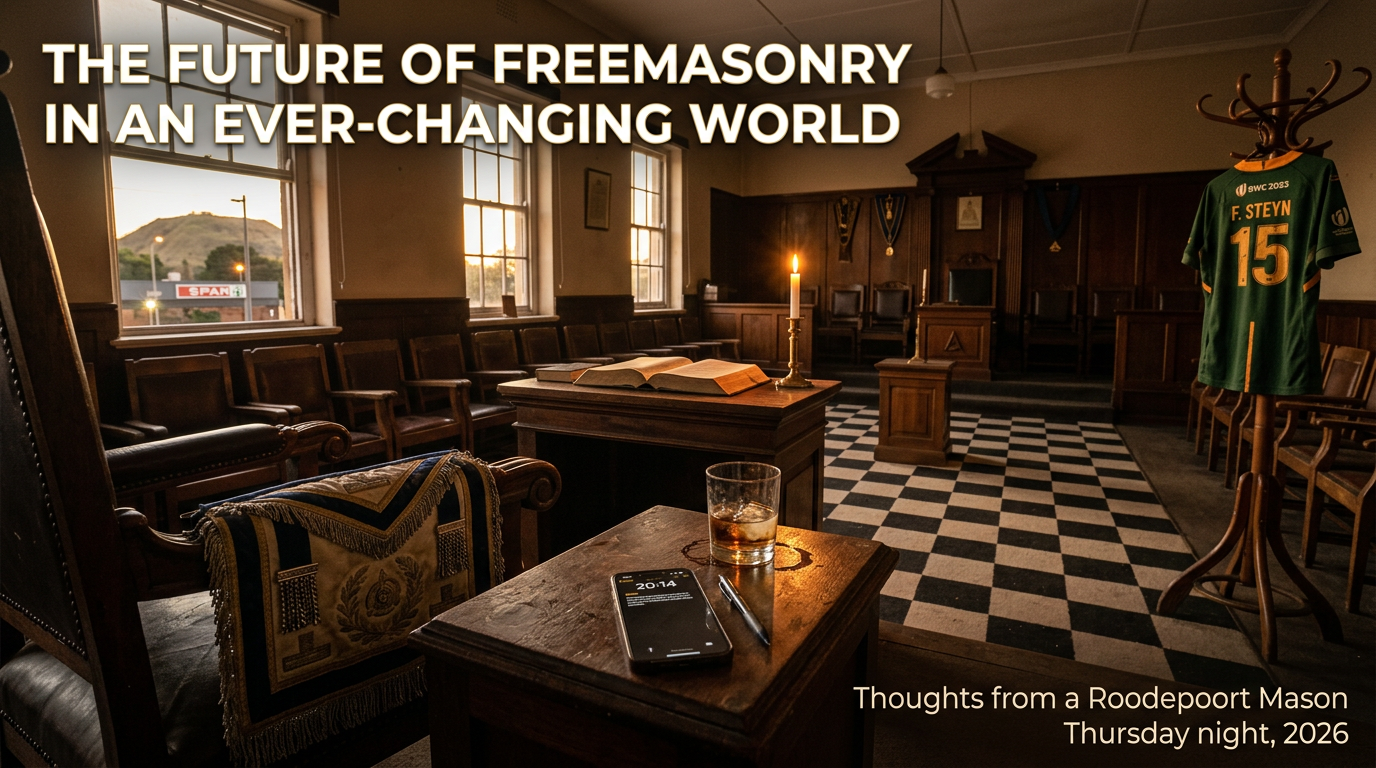
It's 11:47 on a Thursday night and I'm one of the last ones leaving here again.
The lads have all gone home – some to patient wives, some to empty flats, one poor bugger to a babelaas he's going to regret tomorrow because he can't bloody well say no to "just one more" when Banie brings out that homemade brannas he swears is legal. The caterer locked the front door on our way out.
The Lodge room smeled the way it always does after a good night – that mix of furniture polish, old carpet, the ghost of someone's aftershave, and if I'm honest, a bit of Castle Lager that someone spilled on the bar in about 1987 and has lived in those floorboards ever since. I've tried to describe this smell to my partner and she just wrinkles her nose, but to me it's the smell of home in a way our actual house in Florida Glen has never quite managed.
I'm writing this on my phone, thumb-typing like a pensioner, because I promised the webmaster I'd get something up on the Lodge website before the weekend and it's already bloody Thursday. He keeps sending me reminders with little emoji things I don't understand. Three weeks ago he sent me a fire emoji and a goat emoji after I gave a talk on the working tools and I had to ask my kids what the hell a GOAT was in young-person language. Greatest Of All Time, apparently. I'm still not sure if he was taking the piss.
But sitting here in the quiet, with just the little light above above my desk on because I can't be arsed to walk over to the main switch, I've been thinking.
Dangerous, I know.
I've been thinking about what this Craft is going to look like when my grandson – he's seven now, obsessed with dinosaurs and the Springboks in equal measure – is old enough to knock on a Lodge door. That's 2049, give or take. I'll be around eighty if I'm lucky, probably sitting in a corner somewhere boring the young brothers to death with stories about the old days, which'll be now, which is weird to think about.
Will there even be a Lodge here for him to knock on?
That's not rhetorical doom-saying, by the way. That's a real bloody question that keeps me up at night more than it probably should. We've got maybe twelve or so members on the books at Roodepoort Caledonian. On a good night we get eight in the chairs. On a bad night it's five, and three of those five are there because their wives kicked them out of the house for the evening. Our average age is somewhere around sixty-one..ish. We initiated two blokes last year. We lost good Brethren to the Grand Lodge Above, and some who just stopped answering their phones and we're all too polite to ask why properly.
The maths isn't great, boet.
And it's not just us. I talk to brothers from other Lodges when we visit – when we can be bothered to drive out to Krugersdorp or Rewlatch or wherever – and it's the same story. Everywhere. Different accents, same worried looks. The Craft that felt eternal when I was initiated twelve years ago, when I stood there in the Northeast Corner and thought I'd stumbled into something that had survived Napoleon and two World Wars and would obviously survive anything, now feels sort of... fragile.
That's a hard word to type.
Fragile.
Like if we sneeze wrong the whole thing might just pack up and become a historical footnote, something they'll mention in documentaries about the 18th century between the bits about powdered wigs and the American Revolution. "And here we see the Freemasons, a curious social phenomenon of the Enlightenment, now mostly extinct except for a few die-hards in provincial towns who meet in dusty buildings and mumble about geometry."
Bugger that.
I didn't spend nine years learning ritual and two absolutely knackering years as Right Worshipful Master, the year we had load-shedding during three separate meetings and we had to meet with candle lights like in days gone by.
So that's what this is about. This long, rambling, probably-too-honest thing I'm going to write tonight before the whisky runs out or my phone battery dies or my partner moan at me to come to bed. I want to think out loud about where we're going. Where we could go. Where we should go. What we're getting right, what we're getting catastrophically wrong, and what the hell we do about it before it's too late.
I'm not a Grand Lodge officer. I'm not a Masonic scholar. I'm a fifty-eight-year-old bloke from the West Rand who works an ordinary job during the day and wears an apron at night because it's the most meaningful thing I've ever been part of and I'll be damned if I'm going to let it slip away without a fight.
Right. Let's do this properly.
The World That's Trying to Leave Us Behind
Here's the thing nobody wants to say out loud at Festive Board: the world doesn't give a rat's arse about Freemasonry anymore.
Actually, let me correct that. The world doesn't think about Freemasonry anymore, which is worse. If they hated us or feared us or thought we were running things behind the scenes, at least we'd be on their minds. But we're not. We're just sort of... there. Like Rotary Club or that building on the corner that used to be a video shop and now you're not quite sure what it is but the lights are sometimes on.
When I was initiated in 2014, I was sort of unusual. I was forty-six, which was young for our Lodge even then. These days when a bloke under thirty-five walks through the door we practically throw a parade. But back then, when I told people I'd joined the Masons, I got reactions. Curiosity, mostly. Some suspicion. One coloured oke I work with asked me straight up if we worship the devil, and I had to explain for twenty minutes that no, boet, we're not Satanists, we're just boring middle-aged men who like symbols and ritual and helping each other out.
Now when I mention it? Blank stares. Or worse – polite disinterest. "Oh, that's nice." Like I'd said I'd joined a book club.
And I get it. I really do. The world's moved on at a pace that would give our founders whiplash.
In 2026 we're living in a reality where teenagers have "chips in their arms for payment", where you can ask your phone a question and get an answer in any language instantly, where my daughter's boyfriend works for a company that doesn't have an office and he's never met his boss in person. Trump's back in the White House for round two, BRICS is trying to dethrone the dollar, AI wrote half the code that runs the apps on everyone's phone, and apparently you can now get a neural implant that lets you control a computer with your thoughts if you're brave enough or desperate enough.
Meanwhile, we're still lighting candles and walking in circles and reciting passages written when they still bled people with leeches.
You can see the problem, right?
It's not that the Craft's principles are outdated – they're bloody not, and I'll fight anyone who says otherwise – but the packaging, the delivery, the whole way we present ourselves feels like it's from a different century. Which, to be fair, it is.
My nephew is twenty-three. He's a sharp kid, university educated, works in digital marketing or social media optimization or some bloody thing I don't fully understand. He can tell you exactly how many people looked at a post, what time they looked, what they clicked on next, where they live, what they had for breakfast. The precision is terrifying. His entire world is optimized, analyzed, A/B tested.
I invited him to an open evening last year. Poor kid sat through a forty-five minute talk on the history of the Lodge building – forty-five minutes, I timed it – delivered by a seventy-one-year-old brother who's lovely but speaks at the pace of continental drift. My nephew was checking his watch by minute twelve. He was on his phone by minute thirty. He left politely, thanked everyone, and I've not been able to get him back since.
"It's just a bit slow." he said in the parking lot. Not mean. Just honest. "And I didn't really understand what you guys actually do."
That stung. Still does.
The attention span thing is real. I sound like an old man saying that – I am an old man saying that – but it's true. We've built a Craft that requires patience, repetition, slow revelation of meaning over years. That's beautiful. That's valuable. But we're trying to sell it to a generation whose longest-form content is a twenty-minute YouTube video, and even then they're watching at 1.5x speed.
Then there's the God thing.
I'm a Christian, sort of. Cultural Christian, my daughter calls it, which I think means I go to church at Christmas and Easter and feel vaguely guilty the rest of the year. But I believe in the Great Architect, in something bigger than ourselves, in a moral order to the universe. That belief is fundamental to Freemasonry. You can't get in the door without it.
But huge chunks of the younger generations? They're done with all that. Not hostile to it like the old atheists were – just indifferent. They're spiritual but not religious, they say. They believe in the universe, in energy, in being good people without needing a cosmic enforcer. And our requirement for belief in a Supreme Being feels, to them, like an unnecessary gate that keeps out good men for no reason.
I've had that argument so many times I could recite both sides in my sleep. "It's not negotiable, it's fundamental, it's what makes us who we are." I know. I agree. But I also know we're losing potential brothers because of it, and I don't have a good answer for that yet.
And then – oh, this one's touchy – there's the whole masculinity thing.
Freemasonry's a men's club. Always has been. That's part of the point, part of the value, a space where men can be vulnerable and honest and work on themselves without the different dynamic that comes when women are in the room. I value that. I need that, if I'm honest.
But bloody hell, the conversation around masculinity has got complicated, hasn't it?
When I was young, being a man was straightforward. You worked hard, you provided for your family, you didn't cry except when the Boks won the World Cup, you sorted your problems yourself or with your mates over a drink. Simple. Clear.
Now? Half the young blokes are being told that traditional masculinity is toxic, that they need to be more open and emotional and vulnerable, that the old ways are harmful. The other half are retreating into this weird aggressive hyper-masculinity thing, all Andrew Tate and alpha male podcasts and crypto millionaires telling them real men don't show weakness.
And we're sitting in the middle of this culture war trying to offer something that's neither of those things, but we don't have the language to explain it properly. We offer brotherhood and self-improvement and moral development, which sounds bloody fantastic, but when you're competing for attention with blokes on TikTok promising you six-pack abs and a Lamborghini in six months, well, we're not exactly winning, are we?
The world's moving faster than we are. That's just a fact. The question is whether we're going to speed up, or dig in, or find some third way that's neither of those things.
I don't know yet. But I know sitting still isn't an option.
Why Half My Lodge Still Thinks WhatsApp is New Technology
Right, time to get honest about what we're doing wrong. And we're doing quite a bit wrong, if I'm being straight with you.
First up: we're old and we act like it.
I don't mean old in years, necessarily, though yes, most of us are collecting pension money and making noises when we stand up. I mean old in attitude. Set in our ways. Resistant to change. Convinced that because something worked in 1987 it'll work now, and if it doesn't work now, that's the world's problem, not ours.
Our Lodge secretary – love him to bits, been secretary for many years, does an incredible job with the paperwork – still types everything on a computer from 2009 and prints it out to file in physical folders. We have a filing cabinet in the anteroom that weighs about the same as a small car and contains every set of minutes going back to 18-voertsek. When I suggested we scan everything and put it on a shared drive, you'd have thought I'd proposed we burn the Grand Constitution.
"What if the power goes out?" he said. "What if the computer breaks?"
And I said, "Boet, we back it up to the cloud, it's stored on servers in three countries."
And he looked at me like I'd started speaking Mandarin.
That's a small example, but it's everywhere. We're scared of technology. We're scared of social media. We're scared of change because change means admitting the old way might not be perfect, and we've invested too much in the old way to let it go.
We had a Lodge meeting in 2024 where someone proposed we start a Lodge Social Media account. Just to post pictures from open evenings, maybe share a quote now and then, let people know we exist. Nothing mad. The proposal got voted down. The main objection? "It's not dignified."
Not dignified.
Meanwhile, every sports club, every church, every community group, every business in the world is on social media because that's where people are, but we're too dignified for that, apparently. We're going to maintain our dignity right up until the last brother turns off the lights and locks the door for the final time.
Here's another one: the way we talk.
I love Masonic ritual. I really do. I spent hundreds of hours learning it, and there's something powerful about speaking words that have been spoken the same way for centuries, feeling that connection to all the brothers who've come before. It's moving. It matters.
But let's be honest – half of it is incomprehensible to modern ears.
We're using language from the 1700s. Words nobody says anymore. Sentence structures that require three attempts to parse. And when we try to explain what it means, we often make it worse by adding more archaic language on top.
I watched a bright young candidate ask what "hele" meant – you know, the whole "hele conceal and never reveal" bit – and the brother explaining it used the word "inviolate" in his explanation. The kid nodded politely and I could see in his eyes he had no bloody clue what either word meant but was too embarrassed to ask again.
We're gatekeeping with vocabulary. Not on purpose. But we're doing it.
And the secrecy thing – oh boy, the secrecy thing.
Look, I get it. I value it. The secrets of Freemasonry are part of what makes it special, what creates the bond between brothers, what protects the integrity of the experience. I'm not suggesting we livestream ceremonies on TikTok.
But we've got blokes so paranoid about secrecy that they won't tell their own wives they're going to Lodge. They'll say they're going to a "meeting" like it's something shameful. We've got brothers who won't wear a Masonic ring in public. We've got Lodges that don't have a sign outside because they don't want people to know we're there.
That's not healthy secrecy. That's paranoid secrecy. And it makes us look like we've got something to hide, which then feeds all the conspiracy rubbish online, which then makes us more defensive and secretive, which makes us look more suspicious, and round and round we go.
We should be proud of being Masons. Openly proud. We should be saying, "Yes, I'm a Freemason, and while I can't tell you everything about our ceremonies, I can tell you it's made me a better man and I'm part of something that does genuine good in the world." That's not breaking any obligation. That's just being honest.
But too many of us have been conditioned to think silence equals safety, when actually silence equals irrelevance.
Then there's the way we treat visitors and new candidates.
I've visited maybe twenty different Lodges over the years. The experience ranges wildly. At the best ones, you're welcomed warmly, introduced to everyone, brought into conversations, made to feel like you belong. At the worst ones – and there are a few – you're ignored unless you know someone, left standing awkwardly at the bar while established groups chat among themselves, treated like you're intruding on a private party.
Guess which Lodges are growing and which ones are dying.
We initiated a young guy, twenty-eight, back in 2023. Really keen. Asked great questions during his investigation. Turned up to his Initiation nervous and excited. Beautiful ceremony, everything went smoothly. And then at Festive Board afterwards, he sat next to me and we chatted for maybe ten minutes before I got pulled into something else, and I assumed other brothers would take over and make him feel welcome.
They didn't. He sat there for an hour, eating his chicken pie, checking his phone, while groups of blokes who'd known each other for thirty years talked about people he'd never met and events he wasn't at. He looked miserable. I clocked it too late, tried to rescue the situation, but the damage was done.
He came back for one more meeting. Then we never saw him again.
That's on us. That's entirely on us. We did the ceremony perfectly – every word correct, every movement precise – and we failed completely at the thing that actually matters, which is making a new brother feel like he's part of something.
And the cost. Oh, bloody hell, the cost.
Between Initiation fees, annual dues, dining fees, regalia, Grand Lodge fees, and all the rest, joining Freemasonry can cost you a couple thousand Rand in a year. For us older blokes with established careers and paid-off bonds, that's manageable. For a twenty-five-year-old who's renting a flat and paying off student loans and trying to save for a car? That's a serious commitment.
Some Lodges have tried to address this by offering reduced fees for young members, which is great. Ours hasn't. We tried to raise it at a meeting and got shot down because "everyone should pay the same, it's only fair."
Is it fair? Or is it just rigid? There's a difference.
I could go on. The meetings that drag on until half past eleven because we can't keep to an agenda. The ritual that's sloppy because we don't rehearse enough. The charity work that's minimal because we're all too busy or too tired. The Lodges that feel like museums, where everything's about preserving the past and nothing's about building the future.
We're our own worst enemy sometimes. And the really frustrating part is that most of this is fixable. We just have to want to fix it more than we want to stay comfortable.
The Young Men We're Failing to Reach
Let me tell you about Liam(name and some details changed not to shame any individuals).
Liam's the son of a brother from our Lodge. Twenty-six years old, works in IT, lives in Northcliff, into fitness and hiking and craft beer and all the things young professional guys in Joburg are into now. His dad's been trying to get him to petition for three years. Liam keeps saying "maybe next year."
So at a braai last year – his dad's braai, not a Lodge thing, just a Saturday afternoon gathering – I ended up standing next to Liam at the fire, beers in hand, and I just asked him straight. "Your dad wants you to join. You keep saying no. Why?"
He was quiet for a bit, watching the boerewors spit and sizzle. Then he said, "No offence, but it looks kind of boring."
Fair enough, I said. Tell me more.
And he did. He said he'd been to one open evening with his dad. He said it was a bunch of older guys in suits talking about procedure and history, and nothing anyone said made him understand what the actual point was. What do you do? What's the experience? Why does it matter?
"Like," he said, "I get that it's a brotherhood and there's rituals and stuff, but so's my climbing club, and at least there I'm actually doing something, you know? We're climbing mountains. We're pushing ourselves. There's a point to it."
That hit me hard because he's not wrong.
What are we offering young men in 2026?
Not charity work, because they can volunteer anywhere. Not networking, because they've got LinkedIn and a thousand professional groups. Not friendship, because they've got social circles already. Not meaning or purpose, because we're doing a terrible job of articulating what that meaning actually is.
We're offering... what? Secrecy? Tradition? A fancy apron? That's not enough. It was never enough, really, but you could get away with it when there were fewer options and social institutions were stronger and men were more willing to join things just because their fathers had.
That world's gone.
The young men we're trying to reach – Gen Z, now, and soon Gen Alpha – are different from us in ways that aren't just superficial.
They've grown up entirely online. They've never known a world without the internet, without smartphones, without instant access to any information they want. They're used to curating their own experiences, skipping things that bore them, optimizing everything.
They're anxious. Really anxious. Mental health issues among young men are through the roof. Loneliness, depression, lack of purpose, feeling disconnected from community and meaning. Which is tragic, because those are exactly the problems Freemasonry should be able to address. But we're not reaching them.
They're skeptical of institutions. They've watched churches decline and governments fail and corporations exploit people, and they don't trust big organizations that claim to have their best interests at heart. You can't just say "we're good, trust us" anymore. You have to prove it. Constantly.
They want authenticity. They can smell bullshit from a mile away. They hate anything that feels performative or fake or like you're selling them something. Which is a problem when our entire tradition is based on allegory and symbol and performing rituals, because if we don't help them understand what it means, it just looks like theatre.
They want immediate impact. Not in a selfish way, necessarily, but they want to see results. They want to know their time and money and effort are making a difference. Telling them "you'll understand the deeper meaning in fifteen years" doesn't work. They need wins along the way.
And here's the big one: they want flexibility.
The idea that you're going to commit to showing up at the same place at the same time once a month, every month, for the rest of your life, regardless of what else is happening in your world? That's a hard sell to a generation that's used to flexibility in everything. Work from anywhere. Study online. Watch things on demand. Build your own schedule.
Our rigid meeting structure – second Thursday of every month, seven thirty sharp, suit required, sit through the whole thing even if you're bored – feels oppressive to them. And I'm not saying they're right or we should change everything to suit them, but I am saying we need to understand this is a real barrier.
Liam said something else at that braai that stuck with me. He said, "It feels like you guys are asking me to join your thing. But what I'm looking for is a thing I can help build."
He doesn't want to inherit our Lodge, with all its history and traditions and ways of doing things. He wants to create something new, something that's his. And we don't really have a place for that kind of energy.
What would Freemasonry look like if we designed it from scratch for young men in 2026?
I'm not talking about throwing out the ritual or the principles or the core of what we are. I'm talking about the delivery, the structure, the experience.
Maybe meetings would be shorter and more frequent. Maybe you'd have different tiers of involvement – core members who come to everything, peripheral members who come when they can. Maybe we'd use technology better – virtual study groups, recorded lectures you can watch on your own time, apps for learning ritual.
Maybe we'd be more transparent about what we actually do. Less mystique, more honesty.
Maybe we'd focus less on the dining and formality and more on the actual work – the self-improvement, the philosophical discussion, the community service.
Maybe we'd find ways to let younger members shape things without waiting twenty years to have any authority.
I don't have all the answers. I don't think anyone does. But I know that what we're doing now isn't working, not for the vast majority of young men, and if we don't figure this out soon there won't be enough of us left to figure it out later.
Liam still hasn't joined, by the way. But we're still talking. I'm taking a different approach now – not selling him on the Lodge as it is, but asking him what he'd want from a brotherhood, what would make it valuable to him, and then seeing if there's any way to bridge that gap.
It's slow. But it feels more honest than the old pitch.
The Things That Will Save Us (If We're Brave Enough)
Right. Enough doom and gloom. Let's talk about what actually gives me hope, what I think could turn this thing around if we have the guts to do it.
First, and this is going to sound contradictory after everything I just said, but: we need to get better at the old stuff before we change anything.
I mean the ritual. The actual ceremonies. The thing that makes us Masons and not just a social club.
Because here's the truth – when the ritual is done well, really well, it's transformative. It's powerful. It works. I've seen hard men cry during a Third Degree. I've seen cynics come out of an Initiation looking stunned, like they've experienced something they can't quite put into words. The ritual works.
But it only works when we do it properly.
Too many Lodges are sloppy. Brothers with their heads in books, stumbling through words, rushing because they haven't rehearsed enough, missing the whole bloody point which is to create an atmosphere and an experience that means something.
We should be rehearsing monthly, at least. We should be learning ritual like we're preparing for a performance, because we are. We should be coaching newer brothers, maintaining standards, treating this like it matters.
When I was a new Mason, we instituted mandatory rehearsals. Not popular. Half the Lodge grumbled. But by the end of the year, our ritual was crisp and confident and beautiful, and you could feel the difference. Candidates noticed. Visitors noticed. We noticed.
If we're going to compete with all the other demands on men's time and attention, we need to offer them something they can't get anywhere else. And the ritual – done right, with meaning and precision and heart – is that thing.
So that's number one. Master the basics.
Number two: technology. Properly. Not halfway, not reluctantly, but actually embrace the tools we have.
I'm not talking about Zoom Lodge meetings. We tried that during COVID and it was depressing as hell – a bunch of blokes in little boxes on a screen, no regalia, someone's dog barking in the background, connection dropping every ten minutes. That's not Freemasonry.
But we should have a decent website. A proper active social media presence. A group chat that everyone actually uses. Online resources for learning ritual. A database of members that's actually maintained. Virtual study groups for brothers who can't always make it in person.
One Lodge I know has a brother who does short video explainers on Masonic concepts – five, six minutes each, really well produced, up on YouTube. Things like "What does the square and compass actually mean" or "The history of the Third Degree." Nothing secret, nothing that breaks obligations, just good educational content. They've had thousands of views. They've had people petition because they found those videos and got curious.
That's the kind of thing we should all be doing.
And we need to stop being scared of Google. When people search "Freemasonry Roodepoort," what do they find? Our Lodge website hasn't been updated since 2021 and it looks like it was designed in 2003. That's the first impression we're making. We're telling people, before they ever meet us, that we don't really care about presenting ourselves well.
Fix. The. Website.
Number three, and this one's controversial: we need to have a serious conversation about women.
Now hold on, let me finish before you throw your regalia at me.
I'm not saying we should become co-Masonic tomorrow. I value male-only space. I think there's something important about men working on themselves in the company of other men, without the different dynamic that comes when women are present. I don't want to lose that.
But we can't keep pretending that having literally zero role for women in the Craft is sustainable or fair or sensible in 2026.
Half the blokes in our Lodge are married. Their wives support them, put up with monthly meetings and occasional weekend trips to Grand Lodge, tolerate the time and money commitment, and we offer them nothing in return except maybe a ladies' night once a year where they get to dress up and eat dinner and feel like afterthoughts.
That's rubbish.
Order of the Eastern Star exists. Co-Masonic orders exist. Women's Grand Lodges exist. These aren't new ideas. And yet in South Africa, most of us completely ignore these options and then wonder why wives are unenthusiastic about their husbands joining.
What if we supported parallel women's Lodges? What if we actively encouraged our partners to join Eastern Star or a women's Lodge and we actually cooperated on charity work and social events? What if we created family-friendly Masonic events that weren't just the annual Christmas party?
I know brothers who'd love their daughters to experience something like Freemasonry. Right now, there's no clear path for that. That's a problem.
And before anyone accuses me of going soft or compromising tradition – look, I've read the history. The Landmarks say what they say. I get it. But traditions can evolve without being destroyed. We've changed plenty over the centuries. We used to require Christian belief; now we accept any faith. We used to ban certain professions; now we don't. We used to have qualifications based on physical perfection; we don't anymore, thank God.
The question isn't whether we can change, it's whether we're willing to, and whether the change preserves what's essential while adapting what isn't.
Fourth thing: we need to reconnect with African traditional values.
I've thought about this a lot. Freemasonry came to South Africa with British colonialism, right? That's just historical fact. And for a long time, it was a white man's institution, which is uncomfortable to acknowledge but true.
That's changed, slowly. We're mixed now, at least in theory. But we've still got this very European, very British vibe to everything. The language, the structure, the formality, all of it.
But there's so much in African philosophy – Ubuntu, the emphasis on community, the respect for elders, the initiation traditions, the oral transmission of wisdom – that aligns perfectly with Masonic principles. We should be leaning into that, not ignoring it.
What if we incorporated more African wisdom into our lectures and discussions? What if we drew explicit parallels between Masonic teachings and Ubuntu philosophy? What if we made it clear that this isn't a foreign import you're joining, but a universal brotherhood that can be expressed in African terms just as validly as European ones?
I think that would resonate. I think it would make Freemasonry feel more relevant, more rooted in this place we actually live rather than some idealized version of 18th-century England.
Fifth: we need to massively up our charity game.
We do some charity work. Most Lodges do. But it's often pretty low-key, pretty invisible. We'll donate to a school or support a bursary or help a brother in need, and that's all good, but nobody knows about it.
Why not? Why are we hiding our light under a bushel?
If we're doing good work in the community, we should be visible about it. Not for the glory, but because people need to know what we actually do. We should be organizing events, feeding schemes, mentorship programs, visible community projects where people can see Freemasons showing up and making a difference.
That's attractive to young men. That gives meaning and purpose. That's something concrete you can point to and say, "This is why I spend my Tuesday evenings in a Lodge room."
One Lodge did a massive cleanup project at a local school – repainted classrooms, fixed broken windows, sorted the playground. They wore Masonic T-shirts. They invited the local paper. Made a big thing of it. They got three petitions in the next month from blokes who saw the project and thought, "Those are the kind of guys I want to be around."
That's how you do it.
Sixth, and this is the hardest one: we need to be willing to let some Lodges die.
I know. That sounds brutal. But hear me out.
There are Lodges limping along with three or four active members, meeting in buildings they can barely afford to maintain, going through the motions because nobody wants to be the one to say it's over. That's not sustainable. That's not healthy. That's just sad.
What if, instead of propping up dying Lodges out of sentimentality, we helped them merge with stronger ones? What if we pooled resources, sold off buildings we don't need, concentrated our energy where there's actual life and growth potential?
Some Lodges are in the wrong location, meeting at the wrong time, stuck in patterns that don't work anymore. That's okay. Let them go. Honor their history, preserve their records and regalia, and move on.
It's better to have thirty vibrant Lodges in a province than sixty dying ones.
And finally – and this is the one I'm most excited about – we need to create genuine mentorship structures.
Right now, mentorship in Masonry is sort of ad hoc. Some brothers are good at it, some aren't. Some new candidates get taken under someone's wing, others are left to figure it out themselves.
What if every candidate was assigned a mentor from day one? Not just someone to teach them ritual, but someone to meet with them regularly, discuss the meaning of what they're experiencing, answer questions, bring them into the social side of the Lodge, make sure they're actually getting value.
And what if that mentorship continued? What if progression through the degrees came with structured learning, discussions, reading lists, challenges? What if becoming a Master Mason meant you'd actually engaged deeply with the philosophy and symbolism, not just memorized some words?
We could create a real path of development. Year one: focus on this. Year two: this. By year five, you've read these books, had these discussions, completed these projects, and you're genuinely transformed by the experience.
That's worth joining for. That's worth staying for.
I'm not saying any of this is easy. I'm not saying we all agree on what should change or how fast. But I am saying that if we keep doing what we've always done, we're going to keep getting what we're getting, which is decline.
We need to be brave. That's what it comes down to. Brave enough to change, brave enough to hold onto what matters while letting go of what doesn't, brave enough to risk failure in pursuit of something better.
What We're Actually Doing in Roodepoort (The Good, the Bad, and the Bloody Ugly)
Alright, time to be really honest about our own Lodge, because I can talk in generalities all day but at some point you've got to put your money where your mouth is.
Roodepoort Caledonian Lodge No. 865 was founded in 1897. Seventy-five years old, which makes us fairly well established but not ancient by Masonic standards. Our building's on Andrew Street Street, if you know the area – smallish, brick, needs a coat of paint frankly, but it's ours and it's paid for which is more than a lot of Lodges can say.
We meet on the second Thursday of every month at 7:30 PM. Installation in June, Festive Board after every meeting, recess in December. Standard stuff.
So what are we doing right?
Honestly? The brotherhood's strong. That's our best asset. The blokes who are active genuinely like each other. We hang out outside of Lodge. We help each other when things go wrong. When a Brother had his heart attack a few years ago, we organized a rotation to visit him in hospital, stood by his family. Nobody made a big deal of it. That's just what you do.
That sense of genuine care – that's what keeps people coming back. That's what Freemasonry should be.
Our ritual's pretty good, too. Not perfect, but good. We rehearse maybe eight times a year, which isn't as much as I'd like but it's more than most. We've got a core of maybe six or seven brothers who really know their stuff, and we're trying to pass that on to the younger guys coming through.
The Initiation I mentioned before, in 2014, when the power went out halfway through – that should've been a disaster, but it ended up being one of the most memorable ceremonies I've ever seen. We finished the whole thing by candlelight and phone torches, and there was something about the flickering light and the shadows and the slightly improvised nature of it that made it feel more real, more ancient, like we'd accidentally connected to something older than electricity.
The candidate – he's still active, by the way, and he says that ceremony is the reason he stayed.
So we can do magic when we try.
What are we doing wrong?
Where do I start.
Our social media is mediocre. We've got a Facebook page that gets updated. No Instagram. No Twitter or X or whatever it's called now. When I suggested TikTok I got laughed out of the room, which, fine, maybe TikTok's a stretch, but the point stands.
We're invisible online. And in 2026, if you're invisible online, you barely exist.
Our meetings might be too long. We start at seven thirty and we're often not done until quarter past ten, which would be fine if it was all meaningful content, but it's not. It's admin , nessesary admin, but admin never the less. It's reading minutes from last month that everyone's already seen. It's reports from committees that could've been sent by email. It's discussions about whether we should "change the coffee supplier" that take twenty minutes and resolve nothing.
By the time we get to the actual Masonic content – the lecture, the ritual, the thing we're supposed to be there for – half the guys are checking their watches and thinking about the drive home.
We need to streamline. Cut the fat. Respect people's time.
Our building needs work. The roof leaks. The carpet in the Lodge room is original from 1985 and looks it. The toilets are temperamental. The kitchen's tiny and the fridge sounds like it's preparing for takeoff.
None of that's life or death, but it creates an impression. When a visitor or a potential candidate walks in, they're seeing a building that looks tired and neglected, and they're thinking, "Is this organization tired and neglected too?"
Maybe that's superficial. But first impressions matter.
We're also – and this is the hard one – we're not great at welcoming new people.
I talked about this before in general terms, but it's true of us specifically. We're friendly enough, but we're cliquey. The guys who've known each other for decades hang out together. Newer brothers and visitors can end up on the outside looking in unless they're really pushy about joining conversations.
We initiated three blokes in the last years. One's still active and involved. One comes occasionally. One disappeared after four months and nobody really followed up properly.
That's a failure rate we can't afford.
What are we trying to do differently?
We got the website rebuild. It's happening now, slowly.
We're trying to do more visible charity. We partnered with other lodges on the West Rand to support the heart & soul foundation in Krugerdorp amongs others. It's small, but it's something, and it's getting us out into the community in a positive way.
We started a WhatsApp group that's actually active. Sounds trivial, but it's made a difference. Brothers stay in touch between meetings, share things, have conversations, feel more connected. We've got better attendance since we started using it properly.
We're trying – trying – to get better at follow-up with new members. Assigned mentors, regular check-ins, making sure they're not getting lost in the shuffle.
And we've started exploring open events that aren't formal open evenings.
That's the kind of thing we need more of.
But here's the thing – all of this is happening slowly, against resistance, because a chunk of the Lodge doesn't see the need for change. They're comfortable. They like things the way they are. And I get that, I really do. When you're seventy-five years old and you've been doing something the same way for forty years, being told you need to change is hard.
But we're running out of time to be comfortable.
At one of our meetings, we had a long discussion about membership. The numbers are clear. We're losing more brothers than we're gaining. If the trend continues, we'll be down to twenty active members within five years, and at that point we're in real trouble.
Some brothers said we just need to work harder at recruitment. Put up posters. Advertise. Get the word out.
And I said, as gently as I could, that recruitment isn't the problem. The problem is retention. The problem is that we're not offering enough value to keep the guys who do join. Fix that first, then worry about recruitment.
That didn't go down well with everyone.
But I stand by it.
Roodepoort Caledonian is a good Lodge. It's full of good men doing their best. We've got history and tradition and a genuine sense of brotherhood. But we're not doing enough to secure our future, and unless we get serious about that, we're going to become another statistic, another Lodge that closed down because it couldn't adapt.
I don't want that. I love this Lodge. I want my grandson to be able to knock on this door in twenty years and find something vibrant and alive and worth joining.
But wanting it isn't enough. We have to do the work.
Two Futures (Choose Wisely)
Let me paint you two pictures of what Freemasonry could look like in 2050. Both are possible. Both are already in motion, depending on the choices we make now.
Future One: The Slow Fade
It's 2050. Roodepoort Caledonian Lodge No. 865 closed its doors in 2041. There were three brothers left at the end, average age seventy-eight. They held a final meeting, closed the Lodge with dignity, handed over their charter to Grand Lodge, and that was that. one hundred and fourty four years of history, done.
The building was sold. It's a CrossFit gym now, which is sort of funny in a depressing way – people still gathering there to improve themselves, just in a very different manner.
Most of the Lodges in Gauteng went the same way. The handful that survived merged and consolidated. There are maybe fifteen active Lodges left in the district, down from fivety-odd in the 2020s. Membership across South Africa is in the low hundreds. Meetings happen monthly, mostly men in their seventies and eighties going through the motions, keeping the tradition alive because that's what they've always done.
Grand Lodge still exists, technically, but it's a shadow. No resources for education or outreach. No support for struggling Lodges. Just admin, paperwork, preserving records of a dying institution.
The younger generation knows about Freemasons vaguely, the way they know about Rotary or Lions or any of those mid-20th-century service organizations that seemed important once and now just linger on quietly in small towns. Occasionally someone writes an article about "the last Freemasons" or makes a documentary about "a dying tradition," and there's a brief flicker of nostalgic interest, but that's it.
The conspiracy theories are still there, weirdly. People still think we secretly run the world, which is darkly funny given we can barely run a Lodge meeting. But that's all we are now – a historical curiosity, a conspiracy theory, a fading memory.
The principles of Freemasonry – brotherly love, relief, truth, the pursuit of moral and philosophical development – those things haven't died. They've just found new homes. Other organizations, new movements, secular groups that offer men community and purpose and growth without the ritual and tradition and perceived stuffiness.
And the men in 2050 who would've been great Masons, who need what we offer, they're getting it elsewhere. Or they're not getting it at all, and they're lonely and disconnected and struggling, because there's nothing quite like Freemasonry, but Freemasonry wasn't there for them when they needed it.
That's Future One. It's depressing as hell, and it's entirely possible if we don't change course.
Future Two: The Renaissance
It's 2050. Roodepoort Caledonian Lodge No. 865 is meeting in a new building, smaller but modern, shared with two other Lodges and a co-Masonic order. We sold the old building in 2029 and pooled resources with nearby Lodges, which was controversial at the time but turned out to be the right call.
The Lodge has eighty-five members, average age forty-two. Meetings happen twice a month – one traditional meeting with full ritual and regalia, one more informal gathering focused on education, discussion, and planning community projects. Both are well attended.
We've still got older brothers, of course, and we treasure them. But we've also got a strong contingent of younger men – twenties, thirties, forties – who've joined because we figured out how to make Freemasonry relevant to their lives.
How'd we do it?
First, we got ruthless about quality. Every ceremony is rehearsed properly, performed beautifully. We don't do sloppy ritual anymore. If you're not prepared, you don't take a chair. That sounds harsh, but it maintains standards, and candidates notice the difference.
Second, we embraced technology intelligently. We've got a killer online presence. Website's modern and informative. Social media's active and engaging. We run virtual study groups for brothers who can't always attend in person. We've got an app – yeah, a Lodge app – that has ritual resources, event calendars, charity project sign-ups, and a members-only forum.
Third, we streamlined everything. Meetings are two hours max. Admin happens online between meetings. We respect people's time.
Fourth, we're visible in the community. We run mentorship programs for at-risk youth. We do regular charity projects that people can see and participate in. We partner with other service organizations. People in Roodepoort know who the Masons are and what we do, and they respect it.
Fifth, we created real pathways for women. We supported the establishment of a women's Lodge that shares our building. We work together on charity projects. Wives and partners are welcomed and valued, not treated as afterthoughts. It's still separate traditions – the men meet in their Lodge, the women in theirs – but there's mutual respect and cooperation.
Sixth, we focused on mentorship and development. Every new brother has a mentor. There's a structured learning path that takes you deep into Masonic philosophy and symbolism. Becoming a Master Mason means something, because you've actually done the work.
And seventh – this one's key – we found ways to let younger members lead and innovate without waiting decades for permission. We created project teams where any brother can propose an initiative, gather support, and make it happen. The Lodge became less about preserving the past and more about building the future, while still honoring tradition.
It's working. We're growing slowly but steadily. More importantly, brothers are engaged and enthusiastic. The guys who join tend to stay, because they're getting real value – friendship, purpose, growth, community.
Across South Africa, it's a mixed picture. Some Lodges died, yes. That Future One scenario happened in places that couldn't or wouldn't adapt. But in other places, there's genuine revival. Smaller numbers than the peak, maybe, but higher quality. Men who are actually committed, actually engaged, actually living the principles.
Freemasonry in 2050, in this future, isn't what it was in 1950. It's changed, adapted, evolved. But the core is the same. The ritual still works its magic. The bonds of brotherhood are still real. The pursuit of light and truth and moral development still matters.
And the men in 2050 who need what Freemasonry offers are finding it, and being transformed by it, and passing it on to the next generation.
That's Future Two. It's achievable. But only if we make the right choices now.
The thing is, these futures aren't abstract. They're being decided right now, in 2026, in Lodge rooms across the country, by brothers who are choosing either to dig in and resist change, or to embrace it intelligently.
Every meeting where we go through the motions without passion or purpose – that's a vote for Future One.
Every time we ignore a visitor or fail to follow up with a new candidate – that's a vote for Future One.
Every time we say "we've always done it this way" without asking whether we should still do it that way – that's a vote for Future One.
But every time we do beautiful ritual that moves men's souls – that's a vote for Future Two.
Every time we welcome a new brother warmly and make him feel like he belongs – that's a vote for Future Two.
Every time we try something new, take a risk, adapt intelligently while preserving what matters – that's a vote for Future Two.
We're voting every day. Every decision. Every action or inaction.
Which future do you want?
I know which one I'm fighting for.
A Letter to My Grandson (Who May Never Read This)
Dear Ethan(not his real name0,
You're seven years old right now, which means you're not reading this – if you ever do read it – sometime around 2040 or so, when I'm either a very old man boring you with stories about the old days, or I'm gone and someone handed you this.
Either way, hi.
I want to tell you about something that's been important to me, in case it ever becomes important to you.
You might know already that your grandfather was a Freemason. Might've seen photos of me in regalia – that fancy apron and the jewel I wore when I was Master. Might've heard stories at family gatherings. Or maybe you know nothing about it, because by the time you're old enough to care, maybe it's all gone and forgotten.
I hope that's not the case, but I'm realistic.
Here's what I want you to know:
Freemasonry made me a better man. That's not dramatic, it's just true. I was forty-six when I joined, which seems old to join something, but honestly I needed it at forty-six more than I would've at twenty-six. I was at a point in life where I'd achieved the things I was supposed to achieve – decent job, nice house, family, all that – and I felt sort of empty. Like I'd climbed a ladder and gotten to the top and realized it was leaning against the wrong wall.
Joining the Lodge gave me a new ladder. Or maybe it gave me better questions about which wall I should be climbing in the first place.
The ritual – and I can't tell you the details, those are secret, but I can tell you what it did to me – the ritual made me think about who I am and who I want to be. It used symbols and stories and allegory to get past my defenses and make me confront uncomfortable truths about myself.
It gave me brothers. Real brothers. Men I could trust, men I could be vulnerable with, men who'd show up at two in the morning if I called them, no questions asked.
It taught me that there's more to life than accumulating stuff and chasing comfort. That pursuing wisdom and virtue and understanding actually matters, even if nobody's keeping score.
And it connected me to something bigger than myself – a tradition going back centuries, millions of men over hundreds of years all working on the same project of trying to be better, trying to understand more, trying to leave the world a bit lighter than they found it.
That's a hell of a thing to be part of.
Now, here's the thing, Ethan. By the time you're old enough to think about joining something like this, the world's going to be different in ways I can't imagine. I'm writing this in 2026. You're reading it in, what, 2040? Maybe 2045? That's a whole different world.
Maybe Freemasonry's still around and thriving, because we figured out how to adapt and stay relevant. Maybe it's barely hanging on, a few old men keeping the lights on out of stubbornness and nostalgia. Maybe it's gone completely, and this letter's just a curiosity, a glimpse into your grandfather's life that means nothing to you.
But here's what I hope:
I hope there's still something in your world that offers what Freemasonry offered me. Some way for men to come together, to work on themselves, to support each other, to pursue meaning and purpose beyond just making money and consuming stuff.
Maybe it's Freemasonry. Maybe it's something new.
But if it exists, and if you're the kind of young man I think you're going to be, I hope you find it. Or it finds you.
Because here's what I've learned: life without meaning is empty. Life without brotherhood is lonely. Life without constantly working to be better is wasted.
You're going to get a lot of messages in your life telling you that success is money or fame or power or stuff. That happiness is comfort and pleasure and avoiding difficulty. That meaning is whatever feels good right now.
Those messages are all lies.
Real success is becoming a man of character, integrity, wisdom. Real happiness is connection, purpose, growth. Real meaning is found in service and love and the pursuit of truth.
That's what Freemasonry taught me, anyway.
You're a smart kid, Ethan. Even at seven, I can see it. You ask questions. You think about things. You're kind, which is rarer than intelligence and more valuable.
Whatever you do with your life, wherever you go, whatever you become, I hope you hold onto those qualities. I hope you find good men to walk alongside. I hope you never stop asking questions or seeking truth or trying to be better today than you were yesterday.
And if, somewhere along the way, you end up in a small room with checkered floors and candles burning and men in aprons teaching you lessons through symbols and stories, and you think about your grandfather who did this too, who sat in those same chairs and spoke those same words and felt the weight and beauty of it all – well, that would make me proud beyond words.
But if you don't, if you find your path somewhere else, that's okay too. The form doesn't matter as much as the substance. The apron doesn't matter as much as the man wearing it.
Just be a good man, Ethan. Be kind. Be honest. Be curious. Be brave. Take care of the people who depend on you. Help those who need it. Keep learning, keep growing, keep seeking light in a world that's often dark.
Do that, and you'll be a Mason in spirit even if you never set foot in a Lodge.
I love you, kid. I'm proud of you already. And I'm grateful that in whatever small way, I got to be part of the chain of men stretching back through generations who tried to pass something worthwhile forward to the next generation.
Whether that tradition survives in the form I knew it, I don't know. But I know the principles survive, because they're true, and truth doesn't die just because institutions fail.
You carry it forward now. You and all the other young men of your generation.
Don't let us down. But more importantly, don't let yourselves down.
Be better than we were. That's all any of us can ask.
With love and hope,
Your grandfather
P.S. – If you do ever become a Mason, learn the ritual properly. Don't be lazy about it. It matters more than you think. And take your turn as Master when they ask you, even though it's terrifying and exhausting and you'll wonder what you were thinking. Some of the best years of my life came from that year of service.
P.P.S. – And for God's sake, update the website. If I'm gone and you're in charge and the website looks like it was designed in 2021, I'm going to come back and haunt you. Standards, boet. Standards.
It's nearly one in the morning now. My whisky's empty. My phone's at 9% battery. My back's complaining about this chair and my wife's going to give me grief tomorrow about staying up so late.
But I feel better for having written this. Gotten it out. All the worry and hope and frustration and love I feel for this Craft, down in words where maybe someone will read them and think about them.
I don't know if anything I've said here will make a difference. I'm just one bloke in one Lodge in one city in one country. Freemasonry's a global institution with millions of members and hundreds of years of history. What the hell do I know?
But I know this: every great movement, every important change, starts with individual people deciding it matters enough to fight for. Starts with conversations and arguments and late-night discussions and people who care enough to stay up past midnight typing on their phones in an empty Lodge room.
The future of Freemasonry isn't going to be decided by Grand Lodge policy papers or institutional reforms, though those things help. It's going to be decided by individual brothers, in individual Lodges, making individual choices every day about whether to put in the work or coast, whether to welcome a stranger or ignore him, whether to try something new or hide behind tradition, whether to care enough to fight for this thing or let it slip away quietly.
I'm choosing to fight.
Not with anger or desperation, but with hope and determination and a stubborn refusal to let something this valuable die on my watch if there's anything I can do about it.
Tomorrow night I've got a meeting with those three brothers I mentioned, the little informal group trying to push for change in our Lodge. We're going to talk about next year's programs, about how to improve retention, about whether we should propose a joint charity project with the Lodge up in Krugersdorp.
Small stuff. Local stuff. One Lodge, one decision at a time.
But that's how you build a future, I reckon. Not with grand visions and sweeping reforms, though those have their place. But with daily choices, small improvements, steady work.
Same way you build a cathedral. One stone at a time.
Same way you live the Craft. One degree, one obligation, one moment of being better than you were.
The future of Freemasonry in an ever-changing world?
It's going to be what we make it. Nothing more, nothing less.
And I'm still fool enough to believe we can make it something beautiful.
Right. Time to go to bed, the wife is going to kill me for staying this late again.
But first, one mental last look around our Lodge room. Those chairs where good men have sat for seventy-five years. The altar where we've all sworn our obligations. The walls that have heard laughter and tears, wisdom and nonsense, the best and worst of us.
This matters. It's always mattered. It always will matter.
We just have to make sure there's someone here to matter to.
Light's going off now.
See you next month, brothers.
So mote it bloody well be.

0 Comments