The Word That Changed Everything
There is a single word in the English language that can take a perfectly ordinary organisation and turn it into an object of suspicion, fear, and wild fascination overnight. That word is “secret.”
Think about it for a moment. A neighbourhood gardening club meets weekly, shares pruning tips, and holds an annual flower show. Nobody bats an eyelid. But whisper that the gardening club has a secret — any secret at all — and suddenly the neighbours are peering over fences. What are they really doing in there? Why the closed doors? What are they growing that they don’t want us to see?
It sounds absurd when applied to gardeners. Yet this is precisely the lens through which millions of people view Freemasonry.
I should know, because I have been on the receiving end of that lens more times than I can count. I am a member of Roodepoort Caledonian Lodge #865, operating under the Scottish District Grand Lodge of Central South Africa, and I have been a Freemason for long enough to have collected a rather impressive catalogue of bewildered questions, suspicious glances, and wildly creative accusations from friends, colleagues, and — on one memorable occasion — a very determined stranger at a braai who was absolutely convinced I could confirm the existence of a tunnel running from our lodge building to the Union Buildings in Pretoria.
I could not confirm that. Mostly because no such tunnel exists. But also because, even after patiently explaining what Freemasonry actually involves, the stranger kept circling back to the same word. Secret. You must have secrets. There must be something you are not telling me.
And here is the thing — he was not entirely wrong. There are things I do not share publicly about my Masonic experience. But the gap between what I keep private and what he imagined I was concealing was so vast you could park a freight train in it.
That gap — between the reality of Freemasonry and the perception of Freemasonry — is what compelled me to sit down and write this piece. Not as a defensive exercise. Not as propaganda. Not as a recruitment tool, though if you find yourself curious enough to explore further by the end, I will be genuinely glad. I am writing this because I believe the public deserves better than the distorted, sensationalised, and often completely fabricated picture of our fraternity that has circulated for centuries.
Freemasonry is one of the most misunderstood institutions on the planet. It has existed in various forms for hundreds of years, spans virtually every country, counts millions of members past and present, and has contributed enormously to charitable work, philosophical thought, and community building. And yet, ask ten people on the street what Freemasons actually do, and you are likely to get ten different answers — most of them wrong, several of them alarming, and at least one involving lizard people.
The root of nearly all these misunderstandings traces back to that deceptively simple word: secret.
So here is the question I want to spend the next several thousand words honestly exploring: Is Freemasonry truly a secret society, or is it something quite different — a society with certain private elements? And does that distinction matter?
I believe it matters enormously. And I believe that if you give me your attention through this conversation — and it is a conversation, even if I am doing most of the talking — you will understand why.
Whether you are someone who has always been vaguely curious about the Freemasons, someone who holds deep suspicions, a fellow Mason looking for a well-articulated resource to share with sceptical friends, or an academic researching fraternal organisations, I have written this for you. All of you. With as much honesty as I can offer.
Let us begin where all good stories begin — at the start.
Before the Apron: Where Freemasonry Came From and Why “Secrecy” Followed It
To understand why Freemasonry carries the reputation it does, you have to travel back several centuries — to a time when the word “secret” meant something fundamentally different from what it means today.
The origins of Freemasonry are genuinely fascinating, and they are also genuinely debated. Historians have argued for decades about precise dates and lineages, and I will not pretend to settle those arguments here. What is broadly accepted — and supported by documentary evidence — is that Freemasonry as we know it evolved from the guilds of operative stonemasons who built the great cathedrals, castles, and civic buildings of medieval Europe.
These were skilled tradesmen. Master craftsmen. They worked with stone, geometry, and architectural principles that were extraordinarily advanced for their time. And they had very practical reasons for protecting their knowledge. If you had spent years as an apprentice learning how to cut a perfect ashlar or calculate the load-bearing capacity of a Gothic arch, you did not want just anyone walking onto a building site and claiming to possess your skills. Your knowledge was your livelihood. It was, quite literally, a trade secret — no different from the proprietary formulas guarded by modern corporations.
To protect this knowledge, stonemasons developed systems of recognition. Handshakes, words, and signs that allowed a qualified mason arriving at a new building site to prove his competence and his level of training without carrying written credentials, which most people could not read anyway. These were functional tools, not conspiratorial codes. They solved a practical problem in a world without identity documents, professional licensing bodies, or LinkedIn profiles.
These operative masons gathered in lodges — originally the physical buildings on or near construction sites where workers ate, rested, and discussed the craft. Over time, the lodge became more than a physical space. It became a social and organisational structure.
Now, here is where the transition gets interesting. Beginning perhaps in the late 1500s and accelerating through the 1600s, these lodges began admitting members who were not working stonemasons at all. Gentlemen, scholars, merchants, clergymen — men who were drawn to the philosophical and moral dimensions of the craft rather than the physical ones. The tools of the stonemason — the square, the compasses, the level, the plumb line — were reimagined as symbols of ethical conduct. Squareness meant honesty. The level represented equality. The compasses taught restraint and boundaries.
This was the birth of what we call speculative Freemasonry: a fraternity that used the language and symbolism of stonemasonry to teach moral lessons and foster brotherhood. The Scottish historian David Stevenson did remarkable work tracing this evolution, particularly in Scotland, where some of the earliest records of non-operative Masons joining lodges survive.
And then came 1717 — or thereabouts, since the precise date is itself a matter of some scholarly discussion. Four lodges in London came together to form what would become the first Grand Lodge. This was not a clandestine meeting in a hidden cellar. It happened at a public tavern, the Goose and Gridiron Ale House near St Paul’s Cathedral. They elected a Grand Master. They announced themselves. They were, by the standards of the day, remarkably open about what they were doing.
Six years later, in 1723, James Anderson published what became known as Anderson’s Constitutions — a printed book, sold publicly, outlining the history, rules, and regulations of the fraternity. You could buy it. Anyone could buy it. It was not smuggled out of a vault. It sat on booksellers’ shelves.
So from its very earliest formal organisation, Freemasonry was doing something that no genuinely secret society would ever do: publishing its governance documents and holding its founding events in public establishments.
But — and this is a crucial “but” — the fraternity did retain certain private elements from its operative past. The modes of recognition. The content of the initiation ceremonies. The internal workings of the lodge meeting. These were kept within the brotherhood, partly out of tradition, partly because the initiatory experience was understood to have a transformative power that depended on the candidate not knowing what was coming.
And this is where the trouble started.
Because the public could see the buildings. They could see men of influence entering and leaving. They could see the aprons and the regalia. But they could not see what happened inside. And in the gap between visibility and mystery, human imagination did what it always does — it filled the silence with stories. Some of those stories were benign. Many were not.
In South Africa, Freemasonry arrived with the colonial powers. Dutch lodges were established at the Cape as early as the mid-eighteenth century, and British military and civilian lodges followed as the British presence expanded. By the nineteenth century, lodges were operating in towns and cities across the country — including in the mining communities of the Witwatersrand, where men from diverse backgrounds found fellowship in the lodge room. Roodepoort, with its own history tied to the gold mining era, was very much part of this tapestry. Lodges in these communities were not hidden. They built halls. They participated in civic life. Their members were known.
Yet the “secrecy” label stuck. And it has followed us ever since.
The Three Words People Confuse — And Why the Confusion Matters
If I could give every person who has ever raised an eyebrow at Freemasonry a gift, it would not be a Masonic ring or an invitation to a lodge dinner. It would be a dictionary. Specifically, a dictionary that clearly distinguishes between three words that get tangled together so often that most people have stopped noticing they mean entirely different things.
Those words are secret, private, and sacred.
Let me untangle them, because the entire debate about Freemasonry’s relationship with secrecy hinges on understanding the difference.
Secrecy implies deliberate concealment — usually with an ulterior motive. When we say someone is being secretive, we are suggesting they are hiding something that, if revealed, would expose wrongdoing, manipulation, or deception. Secrecy carries a moral charge. It whispers: they are hiding this because they know it is wrong.
Privacy is something else altogether. Privacy is a right. It is a value. It is something every human being, every family, every organisation, every government, and every business practises and protects — and that society broadly agrees is legitimate and necessary. Your medical records are private. The conversations you have with your attorney are private. What a company discusses in its board meetings is private. What you say to your priest, your rabbi, your imam, or your therapist is private. Nobody accuses your doctor of running a conspiracy because they will not discuss your blood test results with your nosy neighbour.
Sacredness is different again. Something sacred is held in deep reverence. It is shared only in appropriate contexts — not because it is shameful, but because its meaning and power are connected to the setting in which it is experienced. Many religious traditions understand this instinctively. The innermost rites of various faiths are reserved for initiates, for the faithful, for those who have prepared themselves to receive them. This is not secrecy. It is reverence.
Now, when people accuse Freemasonry of secrecy, they are applying the first definition — the one loaded with suspicion and moral accusation. But the things Freemasonry actually keeps close to its chest fall squarely into the second and third categories. Privacy and sacredness. Not secrecy.
The modes of recognition — the handshakes, the passwords — are private. They serve a specific fraternal function, and sharing them publicly would simply render them meaningless. Imagine publishing the password to your online banking account. It is not that the password is sinister. It is that making it public defeats its entire purpose.
The ritual ceremonies are sacred. They are designed as experiential journeys — dramatic, symbolic, and deeply personal. A man who goes through the ceremony of being made a Freemason undergoes something that is meant to move him, to challenge him, to shift his perspective on his own life and conduct. That experience depends on not knowing what comes next. It is, if you will, the ultimate spoiler-free experience. Revealing every detail in advance would not expose a conspiracy. It would simply rob future candidates of a profound personal moment.
There is a phrase that some Masonic writers have used — and I find it beautifully apt: “These are not secrets that cannot be told, but truths that cannot be communicated.” What they mean is that even if I sat you down and recited the entire ceremony word for word, I could not give you the experience of it. Just as reading every travel guide about Table Mountain cannot replicate the feeling of standing on its summit with the wind in your face and the Atlantic spread below you. Some things must be lived. That is not secrecy. That is the nature of human experience.
And this distinction — this seemingly academic parsing of vocabulary — matters enormously. Because when people believe Freemasonry is secretive, they assume the worst. But when they understand that Freemasonry is private in the same way that countless other legitimate organisations are private, the accusation loses its power. Not because Freemasonry has changed, but because the framing has been corrected.
Behind the Tyler’s Door: What We Actually Keep Private (And Honest Reasons Why)
I want to be straightforward in this section, because credibility is built on honesty — not on evasion. Freemasonry does maintain certain things as private. I will not pretend otherwise. Let me tell you exactly what those things are, and exactly why they remain private.
The modes of recognition. These are the handshakes — we call them grips — along with certain words, signs, and tokens associated with each of the three degrees of Craft Freemasonry: Entered Apprentice, Fellow Craft, and Master Mason. Their origin, as I mentioned earlier, lies in the operative craft. A stonemason travelling from one building site to another needed to prove, without paperwork, that he was who he claimed to be and that he possessed the level of skill he professed. The grip and the word associated with each level of training served as that proof.
Today, the practical necessity has disappeared — we have membership cards and records — but the symbolic significance remains. These modes of recognition connect us to a tradition stretching back centuries. They are also a fraternal bond: knowing that the Brother sitting across from you in a lodge meeting in Johannesburg shares the same signs as a Brother in Edinburgh, in Mumbai, in Melbourne, or in Montreal creates a tangible sense of universal connection. Making them public would not reveal any scandal. It would simply erode a tradition that holds meaning for millions of men worldwide.
The specific content of the degree ceremonies. Each of the three degrees in Craft Freemasonry involves a ceremony — a ritual — through which a candidate progresses. These ceremonies are dramatic, allegorical, and rich with symbolism drawn from the building of King Solomon’s Temple, from geometry, from moral philosophy, and from the working tools of the stonemason’s trade.
I remember my own initiation vividly. I will not share the specifics of what was said or done — not because it was dark or disturbing, but because it was meaningful in a way that depended entirely on my experiencing it without foreknowledge. I walked into that lodge room as a man with preconceptions and walked out as a man who had been given something to think about for the rest of his life. Every Mason I know has a similar story. The power of the experience lies in its immediacy and its surprise.
And here is the irony: the ritual content is not really secret at all. Exposés have been published since the 1700s. Samuel Prichard released Masonry Dissected in 1730, just thirteen years after the formation of the first Grand Lodge. Since then, dozens of books, pamphlets, websites, and even YouTube videos have revealed virtually every word of the standard Masonic ceremonies. If you genuinely want to read the rituals, you can find them with a five-minute internet search. They are, as many Masons have wryly observed, the worst-kept secrets in the history of civilisation.
What you cannot get from reading them on a screen is the feeling of living through them. The atmosphere. The solemnity. The personal resonance. That is what we protect — not the words, but the experience. And I do not think that is unreasonable.
Internal lodge business and discussions. When a lodge meets, it conducts administrative business alongside its ceremonial work. This includes things like ballot results on new membership applications, discussions about benevolence (financial assistance to members or their families in distress), disciplinary matters, and internal governance decisions. These are kept private for the same reasons that any organisation keeps its personnel and welfare discussions confidential — to protect the dignity of the individuals involved.
If a Brother is going through financial hardship and applies to his lodge for assistance, his situation is discussed with discretion and compassion. Broadcasting that publicly would be a betrayal of trust, not an act of transparency.
That is the list. Handshakes, ritual content, and internal administrative matters. That is what Freemasonry keeps private.
No political schemes. No financial conspiracies. No world domination strategies. No blood pacts with supernatural entities. No hidden agendas.
I understand that sceptics might say, “Well, you would say that, wouldn’t you?” Fair enough. Scepticism is healthy. But consider this: the things I have just described as private are consistent with what every credible historian, academic researcher, and investigative journalist who has studied Freemasonry in depth has concluded. The mundane truth is simply less exciting than the conspiracy theory.
Everything Hiding in Plain Sight
If Freemasonry is a secret society, it is spectacularly bad at being one. I mean that sincerely. Consider the sheer volume of information about Freemasonry that is not only available but actively published, displayed, and promoted by the fraternity itself.
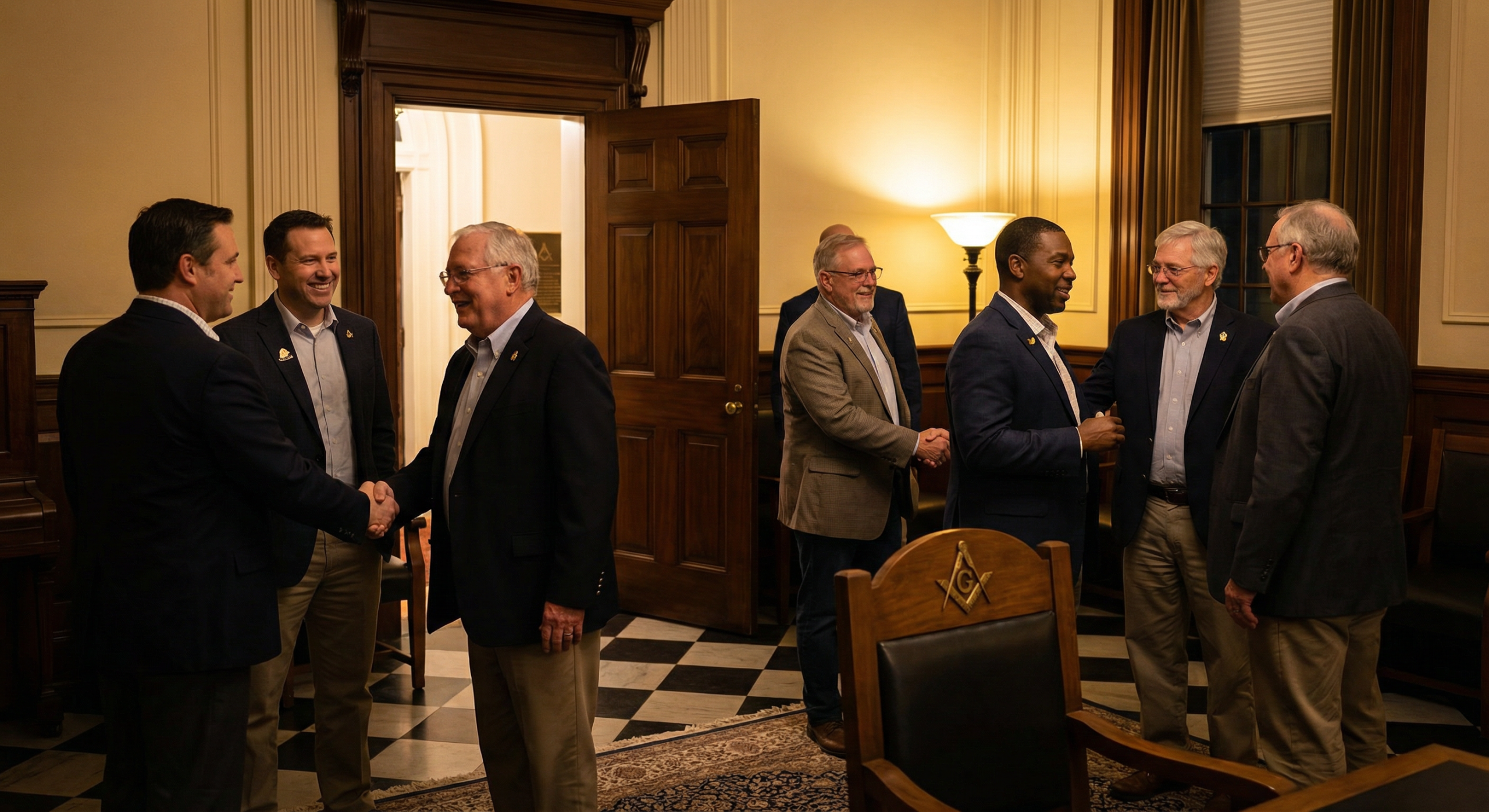
Membership is not hidden. There is no rule in regular Freemasonry that prohibits a member from telling anyone he is a Freemason. I tell people. My family knows. My friends know. My colleagues know. Many Masons wear rings engraved with the square and compasses. They attach emblems to their cars. They wear lapel pins to work. At Roodepoort Caledonian Lodge #865, our members are not skulking around in disguises. We are your neighbours, your co-workers, your friends. We just also happen to meet on particular evenings and wear aprons while we do it.
Our buildings are visible. Masonic halls and temples are often among the most architecturally distinctive buildings in their communities. Many bear the square and compasses prominently above their doors. Some are heritage sites. They are in phone directories. They appear on Google Maps. The idea that we are operating from hidden underground bunkers is undermined rather dramatically by the fact that you can usually see our buildings from the main road.
Our meeting schedules are accessible. Lodge meetings follow regular schedules — often published on websites, in newsletters, or available simply by asking. Roodepoort Caledonian Lodge #865 has a web presence precisely so that anyone who wants to know when we meet, where we meet, and how to get in touch can do so. https://roodepoort-caledonian-lodge.co.za
Our organisational structure is documented publicly. The Grand Lodge of Scottland has a publicly known Grand Master. Provincial and District Grand Lodges have publicly known leaders. Individual lodges have officers — Worshipful Master, Senior Warden, Junior Warden, Treasurer, Secretary, and others — whose names are a matter of record. The hierarchical structure of the fraternity is not classified information. You can find organisational charts in published Masonic yearbooks and on Grand Lodge websites.
Our core principles are openly stated. Brotherly Love. Relief. Truth. These are the three grand principles of Freemasonry, and they are printed in our constitutions, spoken of in our public statements, and displayed on our literature. We are also committed to integrity, respect for the law of the land, tolerance of different beliefs, and charitable service. None of this is whispered in dark corridors. It is proclaimed openly.
Our charitable work is public. Masonic charities operate across the world, and they operate openly. In South Africa, Masonic funds have supported bursaries, medical research, disaster relief, and community development. Globally, Masonic charitable giving runs into hundreds of millions of dollars annually. The Masonic Charitable Foundations associated with the Grand Lodge of Scotland , for example, is one of the largest grant-making charities in the United Kingdom. These are not shadow funds. They are registered, audited, and publicly reported.
Our constitutions and rules are available. The Book of Constitutions of most Grand Lodges — the governing document that lays out the laws, rules, and regulations of the fraternity — is not a classified document. In many jurisdictions, it is available to the public. Anderson’s Constitutions of 1723, the foundational document of organised Freemasonry, has been reprinted countless times and is freely available in libraries and online.
Our history is extensively published. Freemasonry has been the subject of thousands of books — written by Masons and non-Masons alike. Academic historians like Margaret Jacob, David Stevenson, and others have produced rigorous, peer-reviewed scholarship on the fraternity. Masonic libraries and museums exist around the world, many open to the public.
So let me pose a question that I genuinely think deserves an honest answer from anyone who claims Freemasonry is a secret society: What kind of secret society publishes its constitution, erects buildings with its symbols on the front, lets its members wear identifying jewellery, maintains public websites, holds open installations, issues press releases, registers its charities with government regulators, and invites academic researchers to study its archives?
If that is secrecy, it is the most incompetent secrecy in the history of human endeavour.
What it actually is, of course, is not secrecy at all. It is a society that is substantially open and public in its existence, its values, its structure, and its activities — while maintaining privacy around certain specific, limited, and entirely reasonable elements of its internal practice.
Ten Myths That Will Not Die: The Biggest Misconceptions About Masonic Secrecy, Examined Honestly
This is where we get into the thick of it. Over the years — over centuries, really — a set of misconceptions about Freemasonry has calcified into something approaching received wisdom. People repeat these claims so often and with such confidence that they have taken on a life of their own, disconnected almost entirely from evidence.
I want to take on the ten most persistent misconceptions head-on. I will state each one clearly, explain where it likely came from, and offer what I hope is a thorough, balanced, and credible response. Where I can speak from personal experience, I will.
Myth #1: “Freemasonry Is a Secret Society”
The claim: Freemasonry operates in the shadows, hiding its existence, its membership, and its activities from the outside world.
Where it comes from: This is the foundational myth, and it arises from the genuine fact that Freemasonry maintains certain private elements — which, as I have explored at length above, is quite different from being a secret society. The confusion is compounded by centuries of anti-Masonic rhetoric, media sensationalism, and the human tendency to assume that anything not fully transparent must be nefarious.
The reality: I have spent the last several sections of this piece demonstrating why this claim does not hold up. Freemasonry’s existence is public. Its buildings are visible. Its members are identifiable. Its leadership is known. Its principles are published. Its charities are registered. Its history is documented by independent academics. A society that operates this openly is not, by any reasonable definition, a “secret society.”
The more accurate description — and one that many Grand Lodges worldwide have adopted — is that Freemasonry is a private fraternal organisation. It has internal practices that are reserved for members, just as countless other legitimate organisations do. A secret society, in the true sense, would not want you to know it exists. Freemasonry has a website. We are, quite literally, in the phone book.
Myth #2: “Freemasons Secretly Control Governments and World Affairs”
The claim: Freemasonry is the hidden hand behind global politics, finance, and power structures. Freemasons are pulling the strings of governments, banks, and international organisations as part of a New World Order.
Where it comes from: This conspiracy theory has deep roots, and it draws on several historical threads. One is the conflation of Freemasonry with the Bavarian Illuminati — a separate organisation founded in 1776 by Adam Weishaupt, which recruited some Freemasons among its members but was not Freemasonry. The Illuminati was suppressed by the Bavarian government by the end of the 1780s and effectively ceased to exist. Yet the popular imagination — fuelled by conspiracy literature and, more recently, by internet culture — has fused the two into a single imagined entity that somehow still controls everything from the price of bread to the outcome of elections.
Another thread is the undeniable historical fact that many prominent political figures have been Freemasons. George Washington was a Mason. So were Benjamin Franklin, Winston Churchill, and many others. In South Africa, several notable public figures have had Masonic connections. But this is a classic logical fallacy: correlation does not equal causation, and membership does not equal conspiracy. Many political leaders have also been university alumni, church members, and golf club participants. Nobody suggests that the back nine at the local golf course is where world domination is plotted.
A colleague once asked me, with genuine seriousness, whether Freemasonry was “running things behind the scenes.” I laughed — not to be dismissive, but because I had just come from a lodge meeting where we had spent twenty minutes debating the menu of our next supper. If we are the secret world government, we are managing our responsibilities very poorly.
The truth is that Freemasonry explicitly prohibits the discussion of partisan politics within the lodge room. It is one of the oldest and most firmly enforced rules. Masons hold every conceivable political view, and the lodge is designed to be a space where those differences are set aside in favour of what unites us — our shared values and our commitment to brotherhood.
Myth #3: “Masonic Rituals Involve Dark, Occult, or Satanic Practices”
The claim: Behind closed doors, Freemasons engage in occult ceremonies, devil worship, or dark magic.
Where it comes from: The single greatest source of this myth is the Léo Taxil hoax of the 1890s. Gabriel Jogand-Pagès, writing under the pen name Léo Taxil, was a French writer who initially made his name as an anti-Catholic polemicist. He then publicly converted to Catholicism and began producing lurid, sensational accounts of Masonic Satanism — claiming that Freemasons worshipped the devil, conducted obscene ceremonies, and engaged in all manner of depravity. His writings were eagerly embraced by anti-Masonic forces, particularly within certain elements of the Catholic Church.
Then, in 1897, Taxil called a press conference and revealed the entire thing was a hoax. He had fabricated everything. He had invented characters, manufactured evidence, and exploited anti-Masonic prejudice for profit and amusement. He laughed at the people who had believed him.
But the damage was done. The images and accusations Taxil had planted took root in the public consciousness and have proven remarkably persistent. Over a century later, people still repeat claims that trace directly back to a confessed fabrication.
The reality of Masonic ritual is quite different. The ceremonies are allegorical — they tell stories that convey moral lessons. They draw on biblical narratives (particularly the construction of King Solomon’s Temple), on geometric symbolism, and on Enlightenment principles of reason, tolerance, and self-improvement. They are solemn, dignified, and — I can say from personal experience — deeply moving. They are not occult in any meaningful sense. There is no magic. There is no devil. There is no blood.
A Masonic initiation has far more in common with a morality play or a philosophical lecture than with anything remotely resembling dark ritual.
Myth #4: “Freemasons Worship a Secret God Called Jahbulon (or Lucifer)”
The claim: Freemasons worship a deity called Jahbulon, or secretly worship Lucifer, concealing this from lower-ranking members.
Where it comes from: The “Jahbulon” claim originates from certain texts associated with the Holy Royal Arch, a degree that extends beyond the three Craft degrees. The word itself — the precise meaning and usage of which has been debated extensively within Masonic scholarship — was seized upon by anti-Masonic writers and presented as evidence of a secret Masonic deity. Some anti-Masonic authors, notably Stephen Knight in his 1984 book The Brotherhood, amplified this claim to a broad audience.
The Lucifer accusation, once again, traces largely to the Taxil hoax and to a misattributed quotation from the nineteenth-century American Masonic writer Albert Pike. Pike’s writings — dense, verbose, and heavily influenced by comparative religion and philosophy — have been selectively quoted and distorted by critics to suggest he endorsed Lucifer worship. In context, Pike was discussing the Latin meaning of “Lucifer” (light-bearer) in a philosophical treatise, not advocating worship of the devil.
The reality is straightforward. Freemasonry requires its members to profess a belief in a Supreme Being. It does not define that Supreme Being. It does not tell a Christian Mason to stop being Christian, a Muslim Mason to stop being Muslim, a Jewish Mason to stop being Jewish, a Hindu Mason to stop being Hindu, or any man of faith to abandon his own understanding of God. The term “Great Architect of the Universe” is used within Freemasonry as a universal, non-sectarian reference — a way of speaking about the divine that includes all faiths without imposing any one theology.
Freemasonry does not worship anything. It is not a religion. It has no theology, no pathway to salvation, no sacraments, and no clergy. The lodge room is not a church, a mosque, a synagogue, or a temple of worship. It is a meeting place for men of faith who set aside their theological differences to focus on shared moral principles.
Myth #5: “You Have to Be Invited to Join — They Recruit in Secret”
The claim: Freemasonry selectively recruits members through secret invitations. Ordinary people cannot join; you must be chosen.
Where it comes from: This misconception arises partly from Freemasonry’s own tradition that a man must come to the fraternity of his own free will. The phrase “2B1 ASK1” — “to be one, ask one” — encapsulates this principle. Freemasonry does not actively recruit. It does not send out invitations, run membership drives, or go knocking on doors. A man who wishes to become a Freemason must seek out a lodge and ask to be considered.
This tradition has been misinterpreted as exclusivity or secretive recruitment. In reality, it is a matter of respect for individual agency. Freemasonry wants men who genuinely desire to join, who have taken the initiative to learn about the fraternity and who come willingly — not men who have been pressured, persuaded, or lured.
If you are reading this and wondering whether you could join, the answer is quite simple: if you are a man of good character who believes in a Supreme Being, you are welcome to enquire. Visit our website at https://roodepoort-caledonian-lodge.co.za, reach out, and ask your questions. The door is not locked. It simply requires you to knock.
Myth #6: “Freemasons Take Blood Oaths and Are Sworn to Secrecy Under Threat of Death”
The claim: Upon joining, Freemasons swear terrible oaths in which they agree to have their throats cut, their tongues torn out, or their bodies mutilated if they reveal the fraternity’s secrets.
Where it comes from: This one has a basis in historical fact — and I want to be honest about that, because credibility matters more to me than comfort. The traditional Masonic obligations (the promises a candidate makes during each degree) have historically included language describing symbolic penalties. These are dramatic and, frankly, startling when encountered out of context. Phrases describing the cutting of throats, the tearing out of tongues, and the burying of bodies in the sand of the sea have indeed been part of the ritual in various forms for centuries.
But context is everything.
These penalties are symbolic and allegorical. They were never — at any point in the history of regular Freemasonry — intended as literal threats. They belong to the same category of dramatic language found in many ancient oaths and pledges across cultures. They express the seriousness of the commitment being made, in the symbolic idiom of a different era. No Mason has ever been subjected to physical harm for revealing Masonic information. The very idea is absurd.
Furthermore, many Grand Lodges — recognising that this archaic language is easily misunderstood and misrepresented — have revised their ritual wording over the years. Some have moved the traditional penalties into a historical context within the ceremony, or replaced them with more general language about upholding one’s obligations with integrity. The Grand Lodge of Scotland, like most recognised Grand Lodges, takes the welfare and understanding of its candidates seriously and ensures that the obligations are explained and understood in their proper symbolic context.
I remember taking my own obligation. Was it solemn? Absolutely. Was I frightened? No. I understood I was participating in a tradition that asked me to take my commitments seriously and to honour the privacy of my Brethren. That seemed — and still seems — entirely reasonable.
Myth #7: “Freemasons Give Each Other Unfair Advantages in Business, Law, and Politics”
The claim: Freemasons operate a hidden network of mutual favouritism, rigging contracts, court decisions, police investigations, and political appointments in favour of fellow Masons. It is “jobs for the boys.”
Where it comes from: This is perhaps the most persistent and damaging accusation in everyday conversation. It surfaces regularly in British and South African media. It draws on the fact that Freemasonry is, at its core, a fraternal network — and any network of people who know and trust each other can, in theory, be abused for personal advantage.
I will not insult your intelligence by pretending this has never happened. In any organisation of millions of members spanning hundreds of years, there will have been individuals who misused their connections — just as there have been corrupt members of every profession, every faith community, every political party, and every social club in history. Individual misconduct is a human problem, not a Masonic one.
But here is what I will say with absolute conviction: Masonic law explicitly forbids this behaviour. The obligations every Mason takes include commitments to uphold the law of the land, to deal justly and honestly with all people, and to never use Masonic membership to gain unfair advantage. A Mason who perverts justice, rigs a contract, or abuses his position is violating his Masonic vows — not fulfilling them.
Moreover, the idea that Freemasonry operates as a cohesive, efficient, global network of mutual back-scratching gives the fraternity far more organisational credit than it deserves. Anyone who has ever tried to organise a lodge supper will tell you that getting Freemasons to agree on a menu is hard enough, let alone coordinating a global conspiracy.
The accusation also fundamentally misunderstands how Masonic interaction works. In my experience at Roodepoort Caledonian Lodge #865 and in visiting other lodges, the relationships formed are based on shared values and mutual respect — not transactional advantage. When I meet a fellow Mason, my first thought is not “how can this person advance my career?” It is “here is a man who shares my commitment to integrity and brotherhood.” If that sounds naive, consider that the same could be said of friendships formed through church, through university, or through any community group. Connection is not corruption.
Myth #8: “Freemasonry Is a Religion (or Anti-Religion)”
The claim: Freemasonry is either a secret religion with its own god and theology, or it is an anti-religious organisation that seeks to undermine established faiths.
Where it comes from: Both versions of this claim have historical roots. The “Freemasonry is a religion” accusation comes partly from the fact that Masonic ceremonies include prayers, references to a Supreme Being, and the use of a Volume of Sacred Law (typically a Bible, Quran, Torah, or other holy book, depending on the faith of the members present). To an outside observer, this can look religious. The “Freemasonry is anti-religious” accusation comes largely from the historical opposition of the Catholic Church, which has issued several papal bulls and encyclicals condemning Freemasonry since Clement XII’s In Eminenti in 1738.
The reality is that Freemasonry is neither a religion nor anti-religion. It occupies a unique space that confuses people precisely because it is unlike most other organisations.
Freemasonry requires belief in a Supreme Being as a prerequisite for membership. This is not negotiable in regular, recognised Freemasonry. An atheist cannot become a Freemason. But this requirement does not make Freemasonry a religion any more than a hospital chaplaincy programme is a religion because it requires its chaplains to be people of faith.
Freemasonry does not offer salvation. It has no theology — no creed, no doctrine, no articles of faith. It does not tell its members what to believe about God, the afterlife, or the nature of the divine. It has no sacraments, no clergy, and no worship services. A Masonic lodge meeting is not a substitute for church, mosque, synagogue, or temple. It is a meeting of men who share moral values rooted in their individual faiths.
The Catholic Church’s opposition to Freemasonry — which remains technically in place, though its practical enforcement varies — has complex historical and political roots. In the eighteenth and nineteenth centuries, Freemasonry in continental Europe was often associated with liberal political movements, anti-clericalism, and challenges to monarchical and papal authority. The Church’s opposition was driven as much by political power dynamics as by theological objection. In the English-speaking world, where Freemasonry has generally been less politically charged, the relationship between the Church and the Craft has been less contentious — indeed, many Anglican clergymen have been and are active Freemasons.
Myth #9: “Women Are Excluded Because of Secret Misogynistic Agendas”
The claim: Freemasonry excludes women because it is fundamentally misogynistic, and the secrecy surrounding this exclusion proves that the reasons are indefensible.
Where it comes from: Regular, recognised Freemasonry — the mainstream of the fraternity worldwide — is a male-only organisation. This is a fact, and it is one that invites scrutiny in an era rightly committed to gender equality.
I want to address this with the honesty and sensitivity it deserves, because dismissing the question would be disrespectful, and pretending the tradition does not exist would be dishonest.
The male-only nature of regular Freemasonry has its origins in the operative craft. Stonemasonry in the medieval period was a male trade. The lodges that evolved from those trade guilds were, naturally, composed of men. When speculative Freemasonry emerged, it inherited this tradition. The landmark — the foundational rule — that Freemasonry admits only men has been maintained by most recognised Grand Lodges as a matter of tradition and continuity, not as a statement about the worth or capacity of women.
And it is important to acknowledge that Freemasonry is not the only fraternal or social organisation that maintains single-gender membership. Women’s organisations with female-only membership exist and are respected. Single-gender spaces — for men and for women — serve particular social, psychological, and community functions. The existence of a men’s group does not inherently imply hostility toward women, any more than a women’s book club implies hostility toward men.
Furthermore, the Masonic landscape is broader than many people realise. Several organisations exist for women and for mixed-gender membership within the broader Masonic tradition. The Order of Women Freemasons, the Honourable Fraternity of Ancient Freemasons, and the international co-Masonic order Le Droit Humain all admit women and practise Masonic-style rituals. The Order of the Eastern Star, which is affiliated with mainstream Freemasonry in many jurisdictions, includes both men and women. These organisations may not be recognised by regular Grand Lodges as “regular” Freemasonry, but they exist and they thrive.
The conversation about gender in Freemasonry is ongoing, and I suspect it will continue to evolve. What I can say is that the exclusion of women from regular Freemasonry is not a conspiracy, not a secret, and not evidence of malice. It is a tradition rooted in historical context, maintained by institutional choice, and subject to the same debates and discussions that every long-standing institution faces as society changes.
Myth #10: “If Freemasonry Has Nothing to Hide, Why Not Just Make Everything Public?”
The claim: The very fact that Freemasonry maintains any private elements at all is proof that it has something to hide. True transparency would mean opening everything up.
Where it comes from: This is the most intellectually interesting of all the misconceptions, and I have a certain respect for it because it sounds, on the surface, quite logical. If you have nothing to hide, why hide anything?
But the argument collapses the moment you apply it consistently.
Do you share every conversation you have with your spouse with your coworkers? Do you publish your diary online? Does your company release the minutes of every internal meeting? Does your religious community broadcast every private prayer, every confession, every pastoral conversation? Does your therapist post session notes on social media?
Of course not. And nobody accuses you of running a conspiracy because of it.
The right to privacy is not evidence of guilt. This is a principle so fundamental to civilised society that it is enshrined in constitutions and human rights charters around the world. South Africa’s own Constitution, in Section 14 of the Bill of Rights, protects the right to privacy. The existence of privacy is not suspicious. It is normal. It is healthy. It is necessary.
Beyond the principle, there is the practical reality of initiatory experience. Freemasonry’s ceremonies are designed to be encountered, not previewed. Their value lies in the unfolding. A man who enters the lodge room for his initiation not knowing exactly what will happen is in a position to be genuinely moved, challenged, and transformed. A man who has read a spoiler-filled script is simply going through the motions.
Think of it this way. A surprise birthday party is not a conspiracy. A wrapped gift is not evidence of crime. A magician who declines to reveal his technique is not plotting your downfall. Some things are kept private not because they are wrong, but because their meaning, joy, or power depends on the manner of their revelation.
Freemasonry asks for the same courtesy that every other organisation, institution, and individual asks for: judge us by what we do in public, by our fruits, by our impact on our communities and our members — and respect that certain internal matters are ours to keep.
That is not secrecy. That is dignity.
Hollywood, Dan Brown, and the Algorithm: How Media Fuels the Mystery
I will confess something. I have watched National Treasure — both of them — and I enjoyed them thoroughly. Nicolas Cage running around finding hidden Masonic clues in the Declaration of Independence is enormously entertaining. It is also, of course, fiction. But the line between fiction and perceived reality is thinner than most people admit, and the entertainment industry has done more to shape public perception of Freemasonry than any Grand Lodge communication strategy ever has.
Dan Brown’s novels — The Da Vinci Code, The Lost Symbol, Angels & Demons — have sold hundreds of millions of copies worldwide. They are gripping thrillers. They are also built on a foundation of real names, real organisations, and real places mixed with wild speculation, invented history, and dramatic embellishment. Brown himself has acknowledged that his works are fiction, but the “based on real facts” framing that opens his books has led countless readers to assume that the conspiratorial elements are grounded in reality.
Films like From Hell, which imagines a Masonic conspiracy behind the Jack the Ripper murders, and countless other productions have reinforced the idea that Freemasonry is a shadowy force lurking behind historical events. Video games, comic books, television series — the Masonic aesthetic of symbols, aprons, and candlelit rooms has become visual shorthand for “secret evil organisation” in popular culture.
And then there is the internet. Social media and YouTube have created an ecosystem in which conspiracy theories propagate at a speed and scale that would have been unimaginable a generation ago. A single video claiming that Freemasons are behind a global plot can accumulate millions of views in days, while a thoughtful, factual rebuttal posted by a Grand Lodge might reach a few thousand. The algorithm rewards engagement, and nothing generates engagement like fear, outrage, and the thrill of forbidden knowledge.
The “mystery sells” phenomenon is real and powerful. A headline that reads “Freemasons Contribute R500,000 to Local Charity” gets a polite nod. A headline that reads “Secret Masonic Rituals Exposed: What They Don’t Want You to Know” gets clicks, shares, and advertising revenue. Media outlets — from tabloid newspapers to YouTube channels — understand this. And so the mysterious, conspiratorial version of Freemasonry is perpetually amplified, while the mundane, charitable, community-oriented reality struggles for attention.
I do not blame the public for being influenced by this. Media shapes perception. That is what it does. But I do think it places a responsibility on Freemasons and on lodges like Roodepoort Caledonian Lodge #865 to actively engage in public education. For too long, Freemasonry’s institutional culture was one of quiet dignity: “let our actions speak for themselves,” “we do not need to respond to every accusation,” “those who matter know the truth.”
That approach was admirable in a pre-internet world. In the age of algorithmic amplification and viral misinformation, it is a recipe for being defined by your critics. The vacuum left by Masonic silence has been filled — loudly and enthusiastically — by conspiracy theorists, sensationalists, and entertainers. Producing content like this blog post, maintaining active websites, engaging with legitimate media enquiries, and participating in community events with visibility and openness are all ways that modern Freemasonry can reclaim its own narrative.
Not by being defensive. Not by arguing. Simply by being present, honest, and accessible.
The Enemy Within: How Freemasons Sometimes Feed the Beast
Here is where I turn the lens inward, and I do so deliberately. Because it would be dishonest to spend this entire piece blaming outsiders for Freemasonry’s image problems without acknowledging that we have, at times, contributed to them ourselves.
Some Freemasons — and I have met a few — rather enjoy the mystique. They relish the idea that their membership in the fraternity makes them seem mysterious, powerful, or privy to hidden knowledge. When asked about Freemasonry at a dinner party, they will give a knowing smile, perhaps a wink, maybe even the classic deflection: “I could tell you, but then I’d have to…” They think they are being charmingly enigmatic. What they are actually doing is reinforcing every conspiracy theory that has ever been attached to the fraternity. Every wink, every evasive non-answer, every theatrical refusal to discuss perfectly mundane aspects of Masonic life feeds the narrative that we are hiding something sinister.
I have, on more than one occasion, found myself gently correcting a fellow Brother at a social gathering who was playing up the mystery for dramatic effect. “You know,” I have said, “you can just tell them we meet for ceremonies and fellowship and charity. That is literally what we do.” But old habits die hard, and the allure of being seen as a keeper of ancient secrets is, for some, irresistible.
There is also a generational dimension to this. Older traditions of Masonic culture — particularly those influenced by the more reserved British approach to fraternal life — emphasised discretion to a degree that sometimes crossed into unnecessary opacity. “Do not discuss lodge business outside the lodge” was interpreted by some as “do not discuss Freemasonry at all, with anyone, ever.” This excessive caution, well-intentioned as it may have been, created exactly the impression of secrecy that the fraternity could have avoided with a little more openness.
Some Masonic jurisdictions have historically been more closed than others. Grand Lodges in certain countries have been more resistant to public engagement, more reluctant to embrace modern communication tools, and more insular in their outlook. This is changing — and changing rapidly — but the legacy of that insularity lingers in public perception.
I am glad to say that the trend within South African Freemasonry, and within Roodepoort Caledonian Lodge #865 specifically, is toward greater openness. We maintain a website. We are approachable. We are willing to answer questions. We believe that the best antidote to misconception is information — offered freely, honestly, and without defensiveness.
This does not mean we abandon our traditions of privacy. It means we draw a clear, intelligent line between what is private and what can and should be shared. The modes of recognition remain private. The internal ritual remains private. But who we are, what we stand for, what we do in our communities, and why we value our fraternity — all of that is information we should be eager to share.
The modern Freemason, in my view, has a responsibility not just to live the values of the Craft, but to communicate them. Silence in the face of misinformation is not dignity. It is abdication.
On This Ground: Freemasonry in South Africa and the Character of Our Brotherhood
Freemasonry’s history in South Africa is longer and richer than most people realise. The first lodges at the Cape of Good Hope were established under the authority of the Grand East of the Netherlands in the mid-1700s, making Freemasonry one of the oldest continuous institutional presences in the country — older, in fact, than many of the religious denominations and civic organisations that are considered pillars of South African society today.
British lodges followed as British influence expanded, and by the nineteenth century, Freemasonry was woven into the social fabric of communities from Cape Town to the Witwatersrand. Lodges served as gathering places for men of diverse backgrounds — miners, merchants, professionals, tradesmen — who found in the lodge room a space where social distinctions were set aside and a man was judged by his character rather than his station.
The Grand Lodge of South Africa was constituted as a sovereign Grand Lodge, bringing together lodges from various constitutions under a single, independent South African authority. This was a significant step in establishing Freemasonry as a genuinely South African institution rather than a colonial import. Today, the Grand Lodge of South Africa governs lodges across the country and maintains fraternal relationships with Grand Lodges worldwide.
Roodepoort Caledonian Lodge #865 is a lodge that operates under the Grand Lodge of Scottland and like Lodges from other constitutions we share and are in amity with the 4 other Constitutions operating in South Africa. Our lodge, situated in the Roodepoort area of Gauteng, carries forward the Scottish traditions that connect us to the Caledonian — Scottish — heritage embedded in our name, while being thoroughly grounded in the South African context in which we live and serve. Our members come from the community around us. We are part of that community. We are not a foreign implant or an elite enclave. We are neighbours and friends who happen to share a fraternal bond.
I want to address something that is particularly relevant in the South African context: the association, in some minds, between Freemasonry and the colonial or apartheid-era establishment. This is a sensitive topic, and I will not shy away from it.
Freemasonry, like most institutions that have existed for centuries, has reflected the societies in which it has operated — including the injustices of those societies. During the apartheid era, South African Freemasonry, like virtually every other South African institution, existed within and was affected by the racial divisions that defined the country. This is a historical reality that must be acknowledged, not glossed over.
But it is equally important to recognise that Freemasonry’s core principles — brotherly love, equality (symbolised by the level), integrity, and respect for the inherent dignity of every person — are fundamentally at odds with racial discrimination. The Masonic teaching that all men meet “on the level” is not a comfortable platitude; it is a radical proposition that, taken seriously, challenges prejudice and hierarchy.
Modern South African Freemasonry is committed to reflecting the diversity of the nation. The Grand Lodge of Scotland welcomes men of all racial, ethnic, and cultural backgrounds. The lodge room is a space where the divisions that have scarred our country can begin to heal — where men from different communities can sit together as Brothers, united by shared values rather than divided by historical wounds.
There is, I think, a beautiful resonance between Masonic brotherhood and the African philosophy of Ubuntu — the idea that a person is a person through other people, that our humanity is bound up in one another’s humanity. Freemasonry teaches that we are connected, that we have obligations to one another and to our communities, that no man is an island. Ubuntu teaches the same truth in a different language. The convergence of these two traditions on South African soil is something I find genuinely hopeful.
A Hand Extended: What We Ask of You
I have written a great many words now, and if you have stayed with me this far, I owe you my thanks. You have given me your time, your attention, and — I hope — your willingness to consider what I have said with an open mind. That is all I can ask.
I am not asking you to trust Freemasonry blindly. Blind trust is the enemy of informed understanding, and Freemasonry itself teaches its members to seek light — meaning knowledge, truth, and understanding — not to accept claims without examination.
What I am asking for is intellectual fairness.
Judge Freemasonry by its fruits. Look at the charitable work. Look at the communities served. Look at the men — your neighbours, your colleagues, your friends — who are members and ask yourself whether they seem like conspirators or simply like decent men trying to be a little better than they were yesterday.
Ask questions. Genuine, honest questions. If you know a Freemason, ask him about his experience. Most of us are happy — even eager — to talk about what Freemasonry means to us, what we do, and why we value it. We may not share the specific words of our ritual, but we will gladly share the principles, the fellowship, and the purpose that drive us.
If you do not know a Freemason personally, you have options. Visit our website at https://roodepoort-caledonian-lodge.co.za. Send us a message. Ask your questions directly. If we hold public events, attend one. See for yourself who we are and how we conduct ourselves.
And if, in the course of your enquiry, you find yourself drawn to what Freemasonry represents — if the values of integrity, brotherhood, charity, and personal growth resonate with you — then know that the door is open. It has always been open. It simply requires you to knock.
The old Masonic principle is encapsulated in the phrase “2B1 ASK1.” To be one, ask one. We do not recruit. We do not chase. But we warmly welcome every man who comes seeking with a sincere heart.
Full Circle: The Light Behind the Door
I began this piece with the image of a gardening club made sinister by a single word. Let me end with a different image — one that is closer to home.
There is a moment in every Masonic lodge meeting that I have come to treasure. It happens near the beginning, when the lodge is opened and the Brethren settle into their places. The room is arranged with intention — every chair, every symbol, every light has a purpose and a meaning. And for a moment, before the business begins and the ritual unfolds, there is a stillness. A sense of men choosing, deliberately, to step out of the noise and chaos of the world and into a space dedicated to something better.
I cannot fully convey what that moment feels like. I have tried, and words are not quite adequate. It is something you would have to experience for yourself.
And perhaps that — more than anything else — is the real “secret” of Freemasonry. Not a conspiracy. Not a hidden agenda. Not a world-controlling plot. Just a room full of men, drawn from different walks of life, different faiths, different backgrounds, sitting together in pursuit of self-improvement, brotherly love, and service to others. Choosing to be better. Choosing to treat one another with dignity. Choosing to give back to the community. Choosing to build — not with stone, but with character.
The misconceptions about secrecy in Freemasonry are persistent, and they are understandable. Human beings are wired to be suspicious of what they cannot see, and Freemasonry has — through a combination of tradition, historical circumstance, media distortion, and occasional self-inflicted mystification — given the curious plenty of shadows to project their fears onto.
But the shadows are not the substance. The substance is what we do. The substance is the charity given quietly to a family in need. The substance is the friendship forged across lines of age, race, profession, and belief. The substance is the man who walks out of his initiation with a new understanding of what it means to live with integrity. The substance is a fraternity that has endured for centuries — not because it hides, but because what it offers is genuine and good.
Freemasonry is not a secret society. It is a society of men with a shared commitment to timeless principles, a rich tradition of symbolic teaching, and a genuine desire to make the world a little better than we found it. Our privacy protects the dignity of our members and the integrity of our experience. It does not conceal conspiracies. There are none to conceal.
As a member of Roodepoort Caledonian Lodge #865, I am proud of my fraternity. I am proud of the men I sit with in lodge. I am proud of the values we uphold and the work we do. And I am proud to have this conversation with you — openly, honestly, and without apology.
There is a phrase that Masons use often, and I will close with it because it captures something essential about who we are. We speak of seeking “more light” — more knowledge, more understanding, more truth. That is what Freemasonry is, at its heart. A search for light. Not darkness. Not shadow. Light.
If you would like to learn more, I invite you to visit https://roodepoort-caledonian-lodge.co.za. Follow our lodge on social media. Reach out with your questions. Come and see for yourself what the light looks like from inside the room.
The door is there. All you have to do is knock.

0 Comments